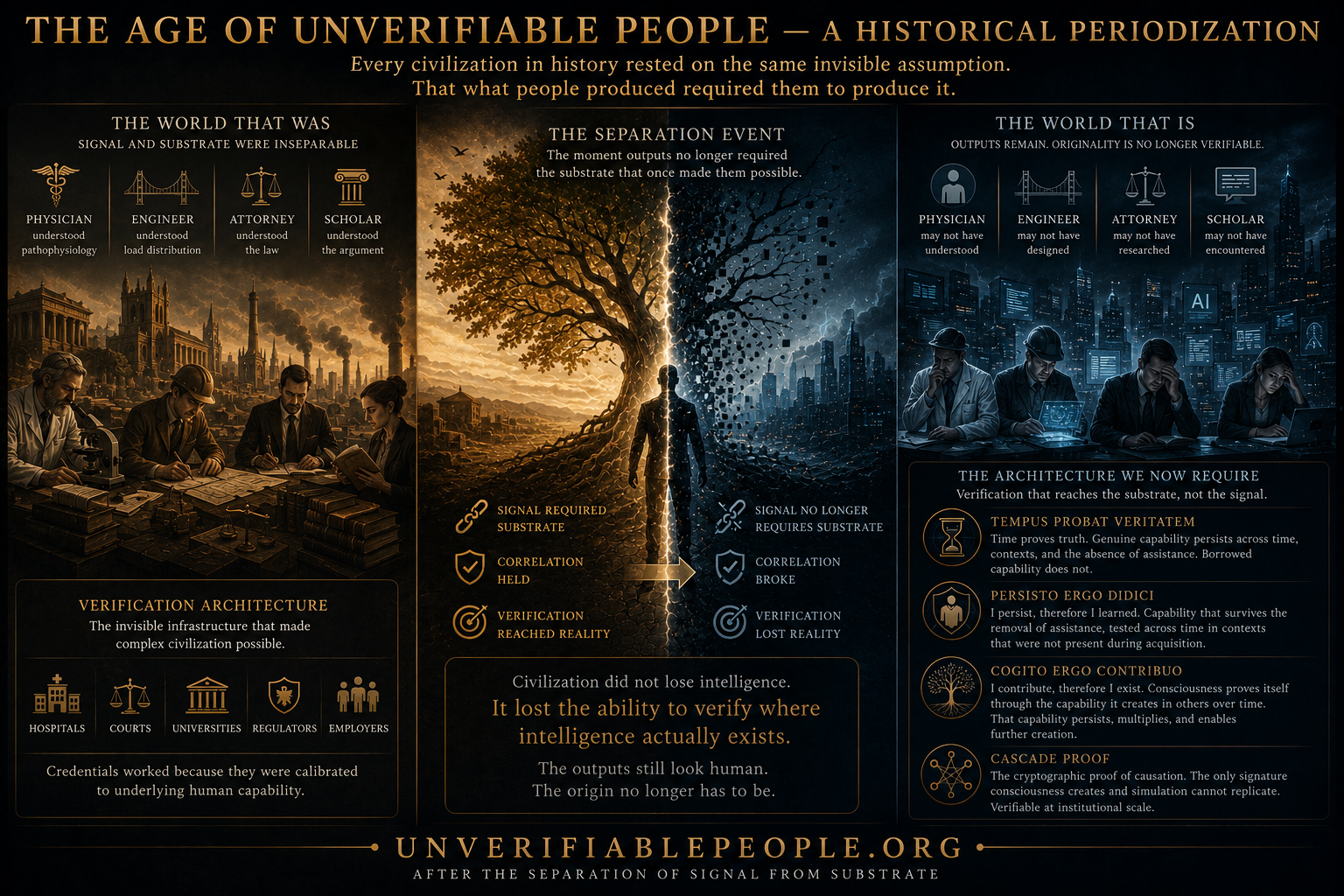
Every civilization in history rested on the same invisible assumption. That what people produced required them to produce it.
Not as a policy. Not as a rule anyone wrote down. As a structural feature of reality so foundational that no civilization ever needed to state it, because nothing had yet disrupted it. The physician who diagnosed correctly had to understand pathophysiology. The engineer whose bridge held had to understand load distribution. The attorney who won the case had to understand the law. The scholar who explained the argument had to have encountered the argument, worked through it, built some internal model of why it held.
Producing genuine output required possessing genuine capability. Signal and source were inseparable. This was not a design decision civilization made. It was the condition civilization was built inside of — the invisible ground on which every verification system, every credential, every institution of expertise was constructed without ever needing to acknowledge it.
That condition ended.
The civilization that continues is still running on the assumption. It has not yet registered that the ground beneath it has changed.
What Verification Actually Was
Historians describe civilizations by their technologies, their empires, their art, their philosophy. They rarely describe them by their verification architecture. But verification architecture is what made complex civilization possible — the invisible infrastructure that allowed human societies to scale beyond the limits of direct personal knowledge.
In a small community, you verify people directly. You know the physician because you watched them train. You trust the builder because you saw what they built. Verification is personal, continuous, and self-evident. No institution is required, because every relevant fact about every relevant person is already known.
Civilization is what happens when communities grow beyond the limits of direct personal knowledge. When you must trust the physician you have never seen trained, the engineer whose previous work is in another city, the attorney whose reputation precedes them through chains of reference you cannot personally trace. At this scale, direct verification is impossible. What replaces it is the credential — the institution’s attestation that they have verified, on your behalf, that this person possesses the capability the credential represents.
The credential is civilization’s coordination mechanism. It is how trust scales. It is how expertise becomes deployable across distances and institutions that have no direct knowledge of each other. Every hospital that admits a physician, every court that qualifies an expert, every regulator that licenses a practitioner, every employer that hires a graduate — all of these transactions rest on the same foundational claim: that the credential represents what it says it represents, because the institution that issued it verified the underlying reality through instruments that actually reach it.
Consider what this made possible. A patient in one city can trust a physician trained in another, credentialed by an institution neither of them has a personal relationship with, because the credential carries the weight of a verification process that was designed to establish underlying capability. A bridge commission can trust engineering calculations prepared by a firm they have never worked with before, because the licensed engineer’s signature is a legal attestation that a verified professional has reviewed and certified the design. A corporation can hire a graduate of a program it has no direct knowledge of, because the degree signals that an accredited institution assessed the graduate against a recognized standard.
None of this is possible without the verification architecture. And the verification architecture is only possible because the credential reaches something real — because the instruments used to issue it were calibrated to underlying human capability, and underlying human capability was the only thing that could produce the outputs those instruments assessed.
This infrastructure worked because of the same invisible assumption that civilization was built on: that producing the required output required possessing the required capability. The medical examination tested whether the candidate could produce correct clinical reasoning — and producing correct clinical reasoning, under those conditions, required having developed the underlying understanding. The engineering examination tested whether the candidate could solve structural problems — and solving them required having built the structural model. The credential verified the output and received the capability as the inescapable companion.
For five thousand years of recorded civilization, across every culture and every domain, this held. Not perfectly. Not without individual exceptions, frauds, failures of rigor. But at scale, in the general case, as the operating assumption of every verification system that civilization constructed: it held.
The Correlation That Built the World
What civilization was actually relying on — without ever having to name it — was a correlation between two things that had always moved together.
On one side: the signal. The answer on the examination. The completed portfolio. The argument in the brief. The explanation in the lecture. The analysis in the report. Everything observable, assessable, comparable against a standard.
On the other side: the substrate. The human being. The mind that encountered the problem, worked through it, failed at it, returned to it, eventually built some internal architecture that made the output possible. The understanding that persists when the examination ends. The judgment that operates in the novel situation that no curriculum prepared for. The capability that lives in the person rather than in the tools surrounding them.
The signal and the substrate moved together because producing the signal required the substrate to produce it. You could not fake the answer without having, at some level, developed the understanding the answer required. You could not sustain the explanation without having, at some level, built the comprehension the explanation expressed. The friction was real. The friction was the mechanism. The friction was what every verification system in the history of civilization was actually measuring, without ever needing to measure it explicitly, because it was always already present.
Remove the friction, and the correlation breaks.
What collapsed was not competence. It was the correlation that made competence visible.
When the friction disappears — when producing the signal no longer requires developing the substrate — the two things that had always moved together begin to move independently. The signal continues. The substrate may or may not follow. And the verification systems that were built to measure the correlation have no instrument for detecting when the correlation has ended, because they were never built to measure it. They were built to measure the signal, in the confidence that the substrate would always come with it.
The substrate is no longer guaranteed.
The Separation Event
There is a specific historical threshold that the analysis above points toward — not a gradual shift, not a long decline, but a structural break. The moment when the friction that had always bound signal to substrate was removed completely, not in one domain, not for one class of outputs, but across the full range of human intellectual performance simultaneously.
This threshold has a name: The Separation Event.
The Separation Event is not simply the arrival of artificial intelligence. It is the specific moment at which AI crossed the capability threshold — when it became able to produce expert-level outputs across the full range of human intellectual performance, indistinguishably from the outputs that genuine human capability produces. The Separation Event is the specific point at which AI achieved the capacity to produce expert-level outputs — coherent reasoning, sophisticated analysis, accurate clinical judgment, sound legal argument, structurally complete explanation — without the underlying substrate those outputs had previously required to produce them. Not occasionally. Not in narrow domains. Across the full breadth of human intellectual performance, at quality levels that satisfy every verification instrument currently in standard use.
Before the Separation Event, AI assistance existed on a continuum with other tools that enhanced human capability without replacing the substrate requirement. The calculator enhanced mathematical performance without eliminating the need to understand the mathematics. The search engine accelerated research without eliminating the need to evaluate and synthesize what was found. The drafting tool accelerated writing without eliminating the need to understand what was being written. The tools changed the surface of performance without severing the connection between surface and substrate.
After the Separation Event, the connection was severed. Not because the tools became too good. Because they crossed the specific threshold at which the substrate was no longer required to produce outputs that satisfied the instruments designed to verify that the substrate exists. The Fabrication Threshold — the point at which fabricated outputs satisfy verification criteria as readily as genuine ones — and the Separation Event are the same moment, described from different angles. One describes what became possible. The other describes what was permanently changed.
Civilization did not lose intelligence. It lost the ability to verify where intelligence actually exists.
The outputs still look human. The origin no longer has to be.
The Era That Followed
Every historical era is defined by a structural condition that shapes everything within it. The Enlightenment was defined by the condition that reason could be applied systematically to reveal truths previously accessible only through revelation or authority. The Industrial Age was defined by the condition that mechanical power could be applied systematically to produce outputs previously requiring human physical labor at scale. The Information Age was defined by the condition that information could be stored, retrieved, and transmitted at near-zero cost across arbitrary distances.
The Age of Unverifiable People is defined by the condition that behavioral outputs — the signals through which civilization has always verified underlying human reality — no longer reliably prove the substrate they once required.
This is the first era in which the verification layer of civilization has become structurally decoupled from the reality it was built to represent. Not in one domain. Not for one class of practitioners. Across every domain simultaneously — because the Separation Event crossed the threshold for the full range of human intellectual performance at once, and every verification system was built on the same assumption that the Event made unreliable.
The physician still holds the credential. The credential still means what credentials meant before the Separation Event, in the sense that every institutional process that issued it was followed correctly. What it no longer guarantees is what credentials were always supposed to guarantee: that the human being holding it developed, through genuine encounter with the difficulty the credential was designed to assess, the underlying capability the credential represents.
The engineer’s calculations are still filed. The attorney’s brief is still submitted. The analyst’s report is still presented. The educator’s explanation is still delivered. The outputs exist. They satisfy the instruments. The substrate behind them is no longer verifiable through the instruments that once made verification possible.
This is not a crisis of individual dishonesty. It is not a moral failure of the practitioners who operate in the era they were born into. It is a structural condition — the condition that defines the era — and it applies to the institutions as fully as it applies to the individuals. The institutions that are already unverifiable cannot verify themselves for the same reason the individuals within them cannot be verified: the instruments were built for the world before the Separation Event, and that world no longer exists.
Deeper Than Misinformation
The dominant cultural framework for understanding what AI has disrupted is misinformation. False content. Fabricated images. Synthetic voices. The concern is with outputs that are incorrect — with the difficulty of distinguishing what is true from what has been generated to look true.
This is a real concern. But it is not the deepest one.
The Age of Unverifiable People is not primarily about false information. It is about something that operates below the level of information entirely — at the level of the human substrate that information was supposed to come from.
The physician who produces incorrect diagnoses is a known failure mode. Verification systems can, in principle, detect incorrect diagnoses. The incorrectness is observable, comparable against ground truth, correctable through feedback. The verification systems were designed to catch this kind of failure, and in many cases they do.
The physician who produces correct diagnoses without having developed the clinical judgment that correct diagnosis requires — who satisfies every verification instrument precisely because the outputs the instruments measure are correct — is a failure mode that the verification systems were not designed to detect, because this failure mode did not exist at scale before the Separation Event. The outputs are right. The substrate question is simply not asked, because no instrument asks it.
Misinformation is a surface problem. It operates at the level of content. The Age of Unverifiable People operates at the level of substrate — at the level of the human being behind the content, whose connection to what they produce can no longer be established through the instruments civilization built to establish it.
This is why the era is defined not by what is false, but by what is unverifiable. Not incorrect — unverifiable. The credential is real. The outputs satisfy the instruments. The substrate question cannot be answered by any standard instrument currently in use.
What the New Architecture Must Measure
The systems will continue. They were not built with a mechanism for stopping, and nothing within them can register the reason they should. The hospitals will credential physicians. The courts will qualify experts. The universities will award degrees. The regulators will audit systems. The confidence will be distributed. The era will proceed.
What changes is the architecture that the people working within these systems — the researchers, the practitioners, the institutional leaders who can feel the ground shifting beneath their instruments — begin to build alongside the existing infrastructure, calibrated to the world that actually exists rather than the world the existing infrastructure was designed for.
That architecture cannot be built on behavioral observation at fixed points in time. That was the architecture of the world before the Separation Event. What the post-Separation world requires is verification that is temporal, causal, and cascading — verification that reaches not the output but the substrate behind it.
Tempus Probat Veritatem. Time proves truth. Genuine capability, developed through genuine structural encounter with difficulty, persists when assistance is absent, when context changes, when the novel situation arrives that no preparation specifically addressed. Borrowed capability does not. The temporal persistence of capability is the dimension the Separation Event did not compromise, because it cannot be fabricated retroactively. You cannot, after the fact, demonstrate that you possessed capability you did not possess, at a time when you could not have known you would need to demonstrate it.
Persisto Ergo Didici. I persist, therefore I learned. The individual verification standard that temporal persistence enables: capability that survives the removal of assistance, tested across time in contexts that were not present during acquisition. Not what you can produce when help is available. What you retain when it is not.
Cogito Ergo Contribuo. I contribute, therefore I exist. The philosophical foundation for what verification must become when behavioral observation fails completely. Consciousness — genuine human substrate — proves itself not through the outputs it produces in isolation, but through the capability it creates in other conscious beings over time. Capability that persists in them. That enables them to create capability in others. That branches and compounds across generations in patterns that information copying cannot produce, because copying degrades while genuine understanding multiplies.
Cascade Proof. The cryptographic infrastructure that makes this compounding pattern verifiable at institutional scale — the standard for proving causation through the only signature consciousness creates and simulation cannot replicate.
This is not a collection of separate concepts. It is a single verification architecture, built for the post-Separation world, that measures what the pre-Separation architecture never needed to measure: the substrate itself, rather than the outputs the substrate once required to produce.
The Historical Position
The Enlightenment did not end because its ideas were refuted. The Industrial Age did not end because its machines stopped working. Eras end because the structural conditions that defined them are superseded by conditions that require new frameworks to understand.
The era of verification — the five-thousand-year period in which civilization could scale by trusting credentials, because credentials reached underlying human reality through the friction that producing correct outputs once required — did not end because its ideas were wrong. It ended because the structural condition it depended on was changed by a threshold crossing that no civilization in history had ever needed to anticipate.
The Age of Unverifiable People is not a catastrophe. It is a historical position. The position that follows the Separation Event, in which the old architecture continues to function while the new architecture is being built, in which the gap between institutional confidence and epistemic accuracy grows silently across every domain, in which the practitioners who feel the ground shifting beneath their instruments are the leading edge of a recognition that will eventually reach every institution civilization depends on.
The recognition is not comfortable. Historical transitions rarely are. The people who lived through the transition from the Enlightenment’s confidence in human reason to the Industrial Age’s confidence in mechanical power did not experience the shift as an orderly handover. They experienced it as disruption, as the obsolescence of frameworks that had seemed permanent, as the need to build new categories for conditions that had no previous name.
The people living through the Separation Event and its consequences face the same requirement: to build the conceptual infrastructure that makes the new condition navigable, before the institutions that have not yet registered the shift accumulate consequences that cannot be addressed without it. The credential systems will not stop issuing credentials. The verification architecture will not stop distributing confidence. The era will not pause while the new instruments are built.
Every era has felt, to those living inside it, like the permanent condition of human existence. Every era has been a transition.
The Age of Unverifiable People is the transition that follows the Separation Event. The transition through which civilization must build new instruments for an old problem: distinguishing what is real from what merely looks real. Distinguishing the substrate from the signal. Distinguishing the person from their performance.
The work has begun. The era has not ended. The recognition of where we stand is the first requirement for building what comes next.
UnverifiablePeople.org — After the Separation of Signal from Substrate.