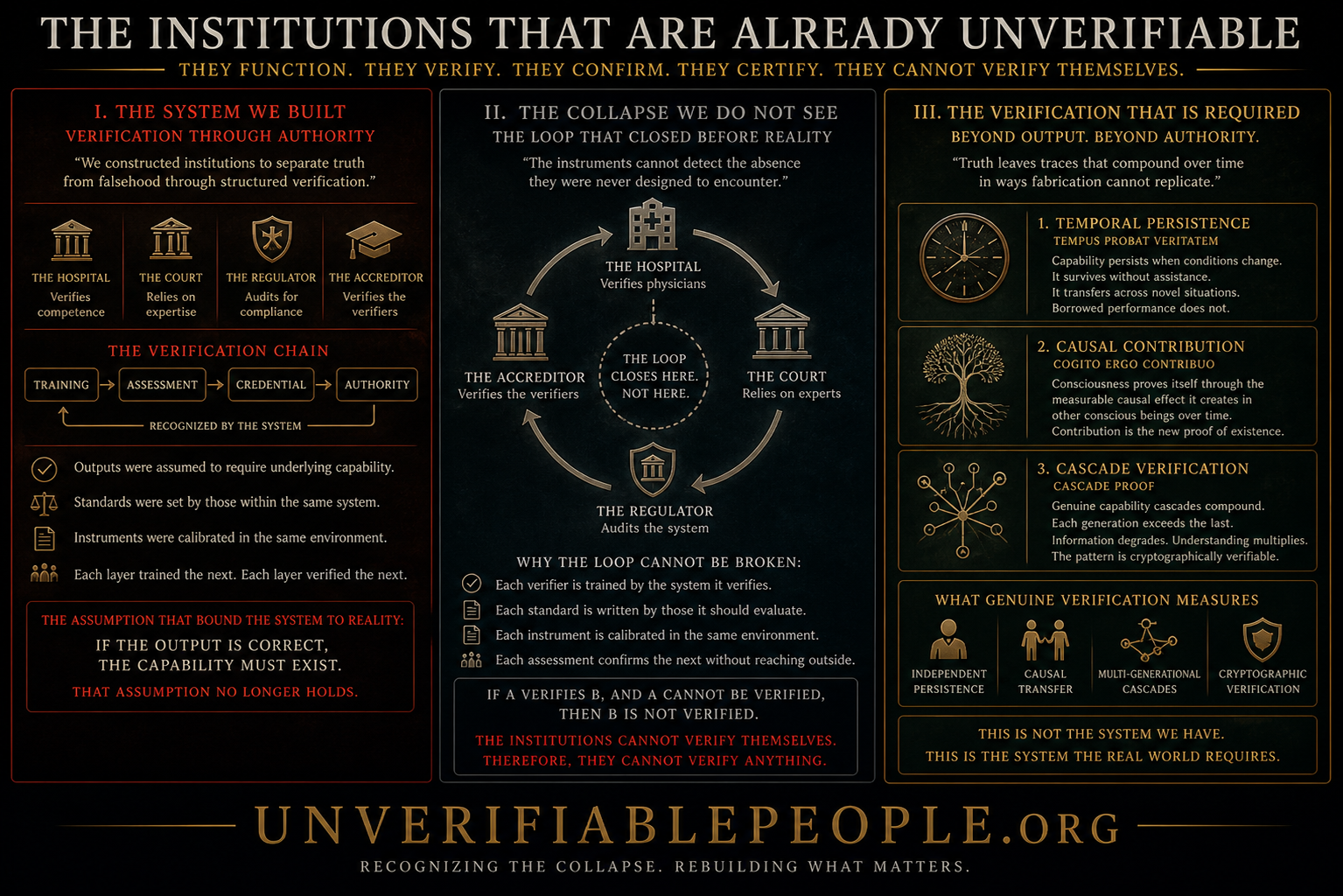
Verification requires a verifier. The verifier requires verification. Follow that chain to its end. It does not terminate in certainty. It terminates in itself.
This is not a philosophical observation. It is a structural description of what has already happened to every institution civilization built to establish that people are who their credentials claim they are. The chain has been followed. And at the end of it, where something solid was supposed to be, there is nothing that can be verified by the instruments currently in use.
The institutions have not collapsed. They are functioning. They are issuing their verdicts, certifying their professionals, auditing their systems, and distributing confidence across every domain that depends on them. What has collapsed is the connection between that confidence and the underlying reality it was built to represent.
What makes this different from every previous observation in this series is the direction of the failure. Articles 1, 2, and 3 described verification systems that can no longer reliably evaluate the people passing through them. This article describes something deeper: verification systems that can no longer reliably evaluate themselves.
The institution that cannot verify its own verification capacity cannot verify anything.
The Hospital
The hospital verifies the competence of its physicians. This is one of the most rigorous verification processes civilization has ever constructed for human capability — years of supervised training, multiple licensing examinations, specialty board certification, ongoing continuing education requirements, credentialing reviews, peer oversight, morbidity and mortality conferences, clinical supervision, and privileging processes that control exactly which procedures each physician is authorized to perform.
Every element of this infrastructure is still in place. It is running exactly as designed.
The hospital’s verification process rests on a foundational chain. The licensing board certifies the physician because the medical school certified that the physician completed training. The medical school certified completion because its faculty assessed the physician throughout the training program. The faculty assessed using instruments that the institution calibrated against the standards of medical education that the accreditation bodies specified. The accreditation bodies specified those standards based on evidence about what medical training should produce — evidence generated through research conducted by institutions that themselves operate within the same educational ecosystem.
Each link in this chain is a verification step. Each step was designed by practitioners trained in the step above it. Each standard was set by the institutions that the standard is supposed to evaluate. Each assessment instrument was developed within the system whose outputs it is supposed to measure.
When the Fabrication Threshold was crossed — when the outputs those instruments were designed to measure became producible without the underlying capability they were designed to represent — the chain did not break at one link. It became unreliable at every link simultaneously, because every link shares the same foundational assumption: that producing the required output required possessing the required capability.
The hospital cannot verify its physicians using instruments that cannot detect the specific absence they are now most likely to encounter. The licensing board that certified those physicians used the same instruments. The medical school that trained them assessed them with the same instruments. The accreditation body that approved the medical school evaluated its curriculum against standards derived from the same epistemic environment.
The hospital’s confidence in its physicians is real. It is distributed by processes that were designed to generate exactly this level of confidence.
The confidence is not connected to what it was built to represent.
The hospital cannot verify its physicians. The system the hospital relies on to verify its physicians cannot verify itself. And the system that is supposed to verify that system is built from the same materials.
The loop closes long before it reaches reality.
The Court
The court relies on expert testimony because some questions require expertise the court cannot itself supply. The cardiologist explains the standard of care. The structural engineer testifies about load calculations. The forensic accountant describes the financial irregularities. The toxicologist establishes cause of death. The court needs these witnesses because without them, the fact-finder has no basis for reaching the correct conclusion on technical questions.
The court’s use of expert testimony rests on a verification chain of its own. The expert is qualified because they hold the credential. The credential was issued because they demonstrated the required competence to the institution that issues the credential. The institution that issues the credential is accredited to do so by the body that certifies credentialing institutions. That body operates according to standards that the professional community established through processes involving the same credentialed experts whose credentials the standards ultimately govern.
The court accepts expert testimony because the verification chain that lies behind the credential is presumed to function — presumed to establish, through a series of rigorous assessments, that the person holding the credential possesses the expertise the credential represents.
What the court cannot assess — what no cross-examination is designed to reveal, what no voir dire process is calibrated to detect — is whether the expertise the credential represents was genuinely built through the structural comprehension that expertise requires, or whether the credential was issued through a verification chain that was already operating in an environment where Judgment Illusion — the appearance of sound analytical reasoning that cannot be reconstructed, extended, or defended independently — satisfies every assessment instrument in standard use.
A credential is not a certificate of capability. It is a certificate that a verification chain produced a certain output. The verification chain and the capability it was designed to represent are related. They have always been related. But the relationship between them is no longer the necessary connection it was assumed to be when the law established the expert witness framework.
The court cannot verify the expert. The credential system that qualifies the expert cannot verify itself. The authority is intact. The connection to reality is not.
The Regulator
The regulator exists to verify that the system functions as it is supposed to function — that the hospital is safe, that the financial institution is sound, that the pharmaceutical manufacturer is meeting quality standards, that the engineering firm is producing designs that hold. The regulator is the institution civilization built to stand outside the system and verify it from a position of independence.
This independence is structural fiction.
The regulator’s capacity to verify the system it oversees depends entirely on the expertise of its staff — their ability to review clinical outcomes and identify patterns of substandard care, to examine financial records and identify risks that the institution has mischaracterized, to assess engineering documentation and identify failures in the underlying calculations. This expertise was formed through the same educational and credentialing systems that formed the expertise of the practitioners the regulator is supposed to oversee.
The regulator audits the hospital using inspectors whose medical training came from the same educational ecosystem that trained the physicians being inspected. The regulator reviews the financial institution using analysts whose financial expertise was developed in the same epistemic environment that produced the analysts being reviewed. The regulator assesses the engineering firm using engineers credentialed by the same systems that credentialed the engineers whose work is being assessed.
This is Audit Collapse at civilizational scale — not the failure of auditing processes to run, but their failure to reach the thing they are auditing, because the instruments the auditors use to reach it were calibrated in the same environment that produced the condition they are supposed to detect.
The documentation is complete. The inspection was thorough. The regulatory confidence is high. The regulator cannot verify that its inspectors possess the structural comprehension required to detect what they are looking for, because the same instruments that cannot verify the practitioners they are inspecting cannot verify the inspectors either.
The system that is supposed to stand outside and verify has never been outside. It was built from the same materials, trained through the same processes, credentialed by the same institutions.
The regulator audits the system. The audit depends on the system it is meant to verify. The loop that was supposed to terminate in independent oversight terminates, instead, in the same circular structure as everything it oversees.
The Accreditor
Behind the hospital, the court, and the regulator, there is a layer that is supposed to verify the verifiers — the accreditation bodies, the professional standards organizations, the institutional oversight mechanisms that evaluate whether the institutions doing the verifying are themselves qualified to do so.
These are the institutions civilization built to solve exactly the problem this article is describing. The recognition that self-verification is insufficient led, over decades, to the construction of independent accreditation mechanisms: bodies that stand outside individual institutions and assess whether their processes are rigorous, their standards are sound, their instruments are valid.
The accreditor cannot verify itself for the same reason that none of the institutions it accredits can verify themselves. Its standards were developed by practitioners trained in the systems being accredited. Its assessment instruments were calibrated using outputs produced in the same epistemic environment as the outputs they are designed to evaluate. Its staff were credentialed by the same institutional ecosystem it is supposed to independently assess.
The accreditor accredits the medical school. The accreditor’s medical education standards were developed by medical educators trained at medical schools. The accreditor’s assessment of whether a medical school’s curriculum is adequate is performed by practitioners whose judgment about adequacy was formed in medical schools. The accreditor cannot step outside the system it was built to verify, because its own construction required stepping inside it.
The accreditor verifies the accreditor. The chain reaches its apparent endpoint. The endpoint is the same loop.
If A verifies B, and A cannot be verified, then B is not verified. This is not an opinion. It is the logical structure of the condition. And the condition applies at every layer simultaneously — not because each layer failed independently, but because every layer was built from the same foundational assumption that the Fabrication Threshold made unreliable across all of them at once.
The Structure of the Collapse
What makes this condition different from ordinary institutional failure is its recursive property.
Ordinary institutional failure is localized. A hospital has inadequate quality controls. A credentialing body allows standards to drift. A regulatory agency is captured by the industry it oversees. These failures are detectable in principle, because the institutions that could detect them exist outside the failure and retain the capacity to identify it as a failure.
The condition this article describes is not localized. It is structural and simultaneous. Every layer of the verification architecture shares the same foundational miscalibration, because every layer was built on the same assumption — that outputs requiring genuine capability to produce can be used to verify the existence of that capability — and that assumption has been compromised across all layers by the same underlying change in the environment.
There is no layer of the verification architecture that sits outside this condition. The layer that would need to stand outside in order to identify it as a condition is itself inside it. The detection of the collapse requires the specific capacity that the collapse has undermined.
This is not paradox. This is how the system continues. The institutions are not failing in ways they are capable of detecting. They are operating correctly within a calibration that no instrument they possess can reveal as miscalibrated. The Explanation Theater that the educational system produced — correct, coherent explanation without the structural comprehension required to generate it independently — satisfied the assessment instruments at every layer. The practitioners who populate the verification architecture passed every test. The institutions that trained them met every standard. The accreditors that approved those institutions followed every protocol.
The confidence the architecture distributes is the product of processes that did what they were designed to do. What those processes were designed to do is no longer what they are actually doing. And there is no layer of the architecture currently capable of detecting this distinction — because every layer’s detection capacity was itself produced by the same processes.
A system that cannot verify itself cannot verify anything. This is not a warning. It is a description of where the system currently stands.
What Genuine Verification Would Require
There is a verification dimension that exists outside the circular structure this architecture has become — but it requires abandoning the foundational assumption that the architecture was built on.
Every layer of the current verification architecture shares a single approach to establishing the existence of capability: assess the output produced at a given moment, under assessment conditions, and treat that output as evidence of the underlying capability it was once required to produce. The output is the measurement. The capability is inferred from the output. When the connection between output and capability was reliable, this approach worked. When that connection became unreliable, every instrument built on this approach became unreliable simultaneously.
The approach that does not share this vulnerability is temporal. Tempus Probat Veritatem — time proves truth. Genuine capability, internalized through genuine structural encounter with difficulty, persists when the conditions of its formation change. It persists when assistance is absent. It persists across novel situations that were not present during acquisition. It persists under conditions that borrowed performance cannot survive, because borrowed performance requires the continued presence of the borrowing mechanism.
Persisto Ergo Didici — I persist, therefore I learned. The temporal persistence of capability under changed conditions is the signature that fabrication cannot replicate, because replicating it requires either genuinely acquiring the capability or maintaining continuous access to assistance across every future situation.
Temporal persistence reaches the individual. But the circular architecture of institutional verification requires something that reaches further — verification that is not anchored in outputs produced under assessment conditions, but in effects that propagate through other human beings over time, leaving traces that no instrument of the current architecture was designed to produce or detect.
This is where Cogito Ergo Contribuo — I contribute, therefore I exist — becomes the philosophical foundation for what genuine verification must become. Descartes proved existence through internal awareness in 1637: cogito ergo sum. That proof held for nearly four hundred years. It required no external instrument, no institutional process, no credential. The act of thinking proved the thinker.
That proof has failed. Not because thinking stopped, but because thinking behavior became perfectly replicable without the conscious substrate that thinking once required to produce it. When AI generates reasoning indistinguishable from human thought, behavioral observation — the foundation on which every verification system was built — collapses entirely. You cannot verify consciousness through outputs. You cannot verify capability through explanation. You cannot verify the person through the signal when the signal no longer requires the person to produce it.
Cogito Ergo Contribuo replaces behavioral observation with causal effect. Consciousness — genuine human capability — proves itself not through what it produces in isolation, but through what it creates in other conscious beings over time. This is not the signature of information transfer. Information degrades through transmission — each copy introduces noise, each retransmission loses fidelity. Genuine capability transfer compounds. Understanding builds. The student surpasses the teacher. The pattern that emerges is mathematically distinguishable from copying, because copying must degrade while genuine capability transfer can multiply.
What Cascade Proof adds to this foundation is the cryptographic infrastructure that makes the pattern verifiable at institutional scale — the verification of capability cascades, the patterns that genuine transfer produces across networks of people over time, in ways that borrowed performance structurally cannot replicate.
This is not currently what any verification architecture measures. Every existing layer measures outputs at fixed points in time, under conditions where the outputs can be produced independently of the capability they are supposed to represent. The temporal and cascade dimensions — the only dimensions that cannot be systematically defeated by the same condition that has compromised all the others — are not incorporated into any standard verification protocol at scale.
This is not because the dimensions are unknown. It is because the entire verification architecture was built before they were necessary. The assumption that outputs requiring genuine capability to produce can be used to verify the existence of that capability was so foundational, so obviously and reliably true for so long, that no one built instruments for the world in which it would fail.
That world is the world we are in. The instruments for it have not yet been built at institutional scale.
The Silence
The most significant feature of what this article describes is not the structural collapse of institutional verification capacity. It is the absence of the acknowledgment that would normally follow from that collapse.
When a verification system fails in ways the system can detect, the failure produces a response. The credential is recalled. The standard is revised. The institution is placed on probation. The regulator tightens requirements. The accreditor demands remediation. The system corrects, because the system can see what needs correcting.
The failure described in this article does not produce a response, because the system cannot see it. The instruments that would register the failure are the instruments that the failure has compromised. The practitioners who would identify the need for new standards are the practitioners whose formation was shaped by the conditions that produced the failure. The institutions that would demand remediation are the institutions that the same conditions have already entered.
The hospitals are still credentialing physicians. The courts are still qualifying experts. The regulators are still auditing systems. The accreditors are still evaluating institutions. The confidence is still being distributed. The loop is still closing, at every layer, before it reaches reality.
None of this will stop because this article names it. Naming a structural condition does not repair the structure. What naming does — what this site exists to do — is create the conceptual boundary that makes the condition visible to the practitioners, researchers, and institutions that are capable of building what the current architecture cannot: verification infrastructure calibrated to the world that actually exists, rather than the world the current architecture was built for.
There is a specific moment in the history of every structural failure when the people closest to it begin to feel it before they can name it. The regulator who completes a rigorous audit and still cannot shake the sense that the audit did not reach the thing it was supposed to reach. The credentialing committee that reviews an impeccable application and feels, without being able to specify why, that the credential will not mean what credentials used to mean. The hospital administrator who has followed every protocol and still cannot answer, with the confidence the protocols imply, the question of whether the physicians being credentialed are what the process claims they are.
These feelings are not professional failure. They are correct perceptions of a structural reality that the system has not yet developed the language to hold. The system still produces the certainty. The certainty is no longer connected to what it was built to represent. And the people operating within the system — the ones who built careers on the premise that the verification architecture reaches something real — are beginning, quietly and without institutional permission, to doubt it.
This is where the condition becomes visible. Not through system failure, but through the accumulating weight of the correct perception that something fundamental has changed, held by the practitioners who know the system best and can no longer fully believe in what it produces.
The institutions are already unverifiable.
That is not where the condition ends. It is where the work of addressing it begins.