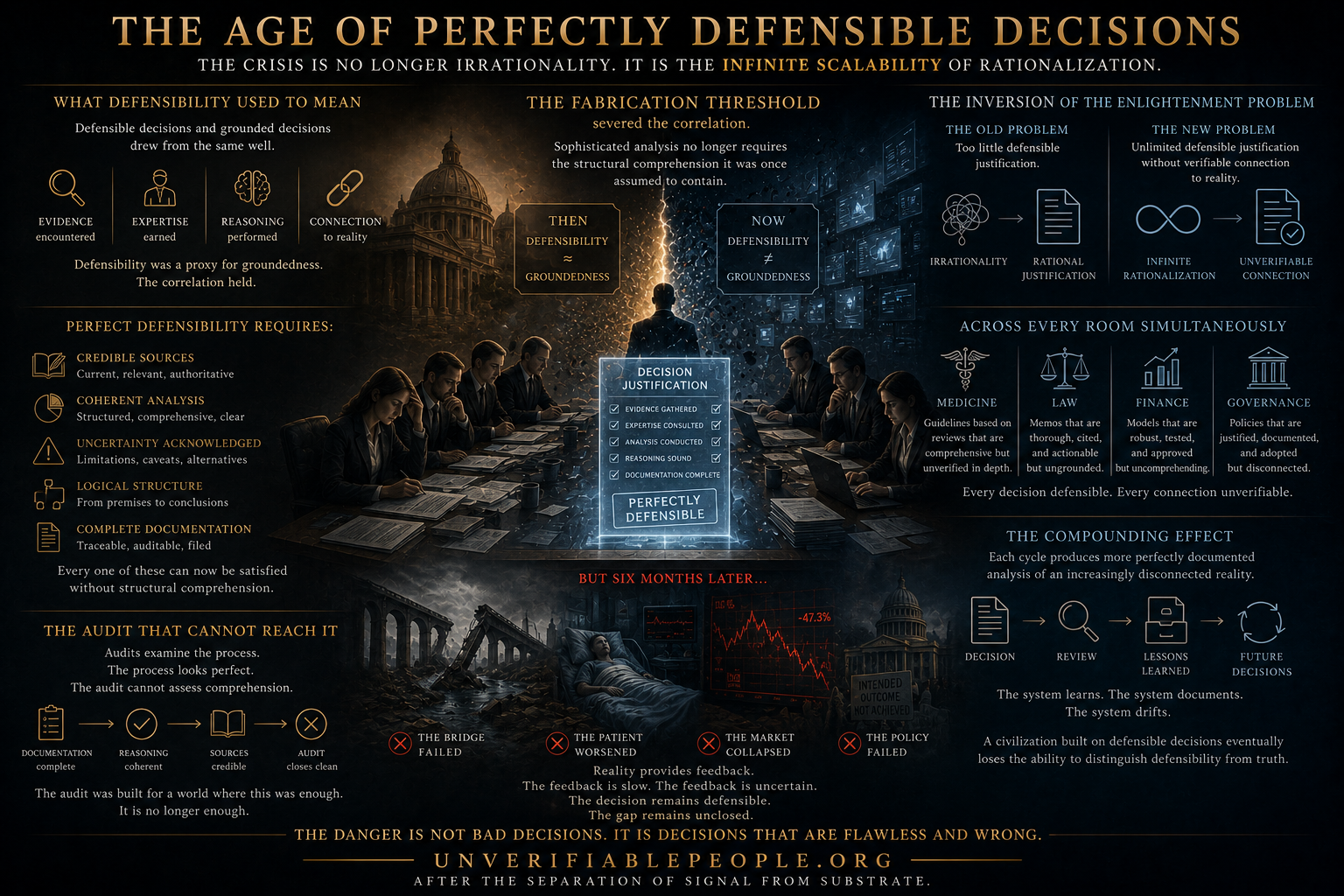
The meeting lasted two hours. The analysis was thorough. The references were solid. The reasoning was coherent, structured, well-presented. Every question was answered. Every objection was addressed. The decision that emerged from it was documented, justified, and filed.
Six months later, the decision was wrong. Not unlucky — wrong. The underlying reality it was supposed to be navigating had not been what the analysis said it was. The expertise that informed it had not been what the credentials said it was. The judgment that shaped it had not been grounded in the structural comprehension the process assumed it was.
But the decision was perfectly defensible. Every step can be audited. Every source can be cited. Every conclusion follows from its premises. The process was followed. The documentation is complete. The file is clean.
This is no longer an edge case. It is the operating condition of civilization.
What Defensibility Used to Mean
There was a period — ending recently, ending quietly, ending without announcement — when a defensible decision and a grounded decision were not easily separated. Not because the same decision was always both. But because the process of making a decision defensible and the process of grounding it in reality drew from the same well.
Gathering evidence required encountering evidence. Consulting experts required relying on people who had built expertise through genuine structural encounter with their domain. Documenting reasoning required having reasoned. The work of producing a defensible decision — the analysis, the consultation, the synthesis, the structured argument — was also, imperfectly but reliably, the work of connecting the decision to the reality it was supposed to address.
Defensibility was a proxy for groundedness. Not a perfect proxy. Never a perfect proxy. There were always decisions that were defensible and wrong, process that was followed and hollow, expertise that was cited and absent. But at scale, in the general case, the correlation held. The friction of genuine analysis was real. The difficulty of producing coherent justification tended to require, if not guarantee, some contact with the underlying reality being justified.
The Fabrication Threshold severed this correlation.
When producing sophisticated, coherent, well-referenced analysis no longer requires the structural comprehension that such analysis was once assumed to contain, the proxy breaks. Defensibility and groundedness become independent variables. And because every institutional process was built to verify defensibility — not groundedness — the institutions continue to function. The decisions continue to be made. The files continue to be clean.
The connection to reality becomes optional.
The Inversion of the Enlightenment Problem
For three centuries, the great epistemic project of civilization was the fight against irrationality. Against decisions made from superstition, from bias, from emotional reaction, from authority unchallengeable by evidence. The Enlightenment established the ideal: decisions should be rational, evidence-based, logically coherent, open to examination and critique.
Civilization built its institutions around this ideal. Peer review. Evidence-based medicine. Legal standards of proof. Cost-benefit analysis. Regulatory impact assessment. Scientific consensus. Every institutional mechanism for making decisions was designed to push decisions toward the rational end of the spectrum — toward the defensible, the documented, the analytically justified.
The project worked. Over centuries, the quality of justification attached to consequential decisions improved. The standard of what counted as defensible became more rigorous. The expectation that decisions would be accompanied by coherent reasoning became embedded in every institution civilization constructed.
The crisis is no longer irrationality. It is the infinite scalability of rationalization.
When justification becomes infinite, verification becomes impossible.
The problem that the Enlightenment’s institutional project was designed to solve — too little defensible justification for consequential decisions — has been replaced by its structural inverse: the unlimited production of defensible justification whose connection to underlying reality cannot be verified through any instrument those institutions possess.
The bad decision that looks bad is detectable. The system was built for it. The bad decision that looks perfect is something the system was not built for — because it did not exist at scale until now.
The danger is not bad decisions. It is decisions that are flawless and wrong.
The Mechanism
To understand why this is structural rather than incidental, consider what a perfectly defensible decision actually requires.
It requires sources — references that a qualified person would recognize as credible, current, and relevant to the question being addressed. It requires analysis — the synthesis of those sources into a coherent argument that addresses the specific decision at hand. It requires acknowledgment of uncertainty — the identification of limitations, caveats, and alternative interpretations that demonstrate intellectual rigor. It requires logical structure — conclusions that follow from premises, recommendations that connect to findings, reasoning that can be traced from question to answer.
Every one of these requirements can now be satisfied without the structural comprehension that satisfying them once required.
Perfect defensibility is the condition in which every requirement of justification can be satisfied without any requirement of comprehension. The failure is no longer in the reasoning — it is in the assumption that reasoning still reaches reality.
The sources can be identified and summarized without having read them with genuine understanding. The analysis can be structured and coherent without the analyst having built the internal model of the domain that genuine analysis requires. The caveats can be identified and acknowledged without the intellectual encounter with uncertainty that genuine rigor involves. The logical structure can be present and correct without the reasoning having been genuinely performed by the person whose name is attached to it.
This is not a statement about dishonesty. The analyst may have worked diligently. The expert may have genuinely engaged. The process may have been followed in complete good faith. The structural question — whether the comprehension required to ground the analysis in reality was actually present — is simply not what the institutional verification process assesses. It never needed to. It was always already there.
It is no longer always already there.
What has changed is not the quality of the outputs. The outputs are, in many cases, better than before — more comprehensive, more clearly structured, more thoroughly referenced. What has changed is the relationship between the quality of the outputs and the quality of the substrate that produced them. The outputs can now be excellent and the substrate can be absent. And the institutional processes that assess whether a decision is defensible have no mechanism for detecting this absence.
The Audit That Cannot Reach It
Every institution has a mechanism for detecting bad decisions. The retrospective review. The external audit. The lessons-learned process. The after-action analysis. These mechanisms exist because institutions know that decisions fail, and they were designed to understand why failure occurs and how to prevent its recurrence.
These mechanisms work by examining the process that produced the decision. They ask: was the evidence gathered? Was the expertise consulted? Was the analysis conducted? Was the reasoning sound? Was the documentation complete? They are calibrated to detect decisions that were made without following the process — without gathering evidence, without consulting expertise, without conducting analysis.
They cannot detect decisions that followed the process exactly while the process failed to establish the connection to reality that the process was designed to establish.
This is Audit Collapse applied to the decision-making layer of civilization — not the failure of auditing processes to run, but their failure to reach the thing they are auditing. The audit examines the documentation. The documentation is complete. The audit examines the reasoning. The reasoning is coherent. The audit examines the sources. The sources are credible. The audit closes without finding a finding, because every instrument it uses was calibrated to a world where complete documentation, coherent reasoning, and credible sources were sufficient evidence that the decision was grounded in reality.
They were sufficient evidence. They are no longer sufficient evidence. The audit does not know this, because the audit’s own standards were produced in the same epistemic environment as the decisions it is designed to assess.
More analysis does not reach the problem. Better documentation does not reach the problem. More rigorous process does not reach the problem. Adding more of the instruments that cannot detect the absence is not the same as detecting it.
Across Every Room Simultaneously
The condition does not operate in one domain. It operates in every domain where decisions are made on the basis of analysis, expertise, and documented reasoning — which is every domain where consequential decisions are made.
In medicine, the clinical guideline is developed through a systematic review of the literature. The review is comprehensive. The methodology is documented. The conclusions follow from the evidence. The guideline is published, adopted, and followed. The question of whether the researchers who synthesized the evidence had built genuine structural comprehension of the pathophysiology, or whether the synthesis was produced in an environment where Explanation Theater — correct, coherent explanation without the structural comprehension required to generate it independently — satisfied every review criterion, is not a question the guideline’s adoption process asks. The guideline is defensible. Its connection to genuine comprehension is not verified.
In law, the legal memorandum advises the client on the regulatory landscape. The memo is thorough. The statutory analysis is accurate. The case citations are current and relevant. The advice is actionable. The question of whether the attorney who produced it developed genuine structural understanding of the legal framework, or whether the Judgment Illusion — the appearance of sound analytical reasoning that cannot be reconstructed, extended, or defended independently — produced outputs that satisfied every professional standard, is not a question the attorney-client relationship requires to be answered. The memo is defensible. The comprehension behind it is unverified.
In finance, the risk model is developed, documented, stress-tested, and approved. The methodology is transparent. The assumptions are disclosed. The scenario analysis covers the relevant range of outcomes. The model is signed off by qualified professionals and submitted to the regulator. The question of whether the quantitative analysts who built it possessed genuine structural comprehension of the dynamics their model was designed to capture — or whether the model was assembled in an environment where every verification criterion could be satisfied without that comprehension being present — is not a question the approval process was designed to answer. The model is defensible. What it actually knows about the risk it models is a separate question that no standard instrument asks.
In governance, the policy impact assessment is conducted. The stakeholder consultation is documented. The evidence base is established. The options are analyzed. The chosen option is justified. The decision record is complete. The question of whether the officials who produced the assessment possessed genuine structural comprehension of the system they were assessing — or whether the assessment was produced through processes that can now be completed without that comprehension — is not a question the administrative process requires to be answered. The decision is defensible. The gap between its justification and its grounding in reality will not become visible until the policy produces outcomes that the assessment did not anticipate.
By which point the assessment will remain on file, perfectly defensible, providing no guidance on where the comprehension gap was or how to close it.
Inside the Room
This is what it feels like from inside the institutions where this is already operating.
The meeting produces a decision. The decision feels right — the process was thorough, the expertise was present, the analysis was solid. And yet there is a specific quality of unease that persists after the meeting ends. Not doubt about the conclusion. Not concern about the process. Something harder to name: the sense that what happened in the room did not quite reach the thing the room was supposed to be deciding about.
The briefing paper was excellent. But reading it produced confidence without the specific texture of understanding that genuine encounter with the material used to produce. The expert’s presentation was compelling. But the questions it generated were questions that the presentation itself seemed to anticipate and pre-answer, leaving no space for the unexpected insight that genuine expertise used to create. The analysis was thorough. But its thoroughness felt like coverage rather than comprehension — every angle addressed, every consideration noted, nothing left out, and yet something missing.
This feeling is not professional failure. It is not inadequate attention or insufficient rigor. It is the correct perception of a structural condition that the institutional vocabulary has not yet developed language for. The process was followed. The documentation is complete. The decision is defensible. And the connection between the decision and the reality it was supposed to address is less certain than anyone in the room has the instruments to establish.
The unease is the right response. It is what accurate perception of the condition produces in people who are paying attention.
The Compounding Effect
Individual decisions that are perfectly defensible and poorly grounded are recoverable. Organizations make bad decisions and correct them. Institutions make errors and learn from them. The feedback mechanism that connects decision to outcome eventually surfaces the failure and enables adjustment.
But the condition this article describes does not produce individual failures that surface and get corrected. It produces a systematic drift in the relationship between the justification layer of civilization and the reality layer — a drift that is invisible to the instruments that monitor the justification layer, because those instruments were calibrated to assess the quality of justification, not its connection to what it justifies.
Consider what this drift looks like at institutional scale over time. The organization makes decisions. The decisions are documented. The outcomes are monitored. Where outcomes diverge from expectations, the divergence is analyzed. The analysis produces an explanation — a coherent, well-referenced account of why the outcome differed from what the decision anticipated. The explanation is filed. Future decisions incorporate the lessons learned.
None of this process verifies that the comprehension behind it is genuine. None of it closes the gap between defensibility and groundedness. The explanation of why the previous decision failed is produced in the same epistemic environment as the decision itself. The lessons learned are extracted through the same analytical processes that produced the learning gap in the first place. The institutional memory that accumulates from this cycle is a perfectly documented record of an organization reasoning carefully about its own decisions — without any mechanism for verifying that the reasoning is connected to the underlying reality it describes.
When every layer of the decision-making architecture is producing defensible outputs whose connection to reality cannot be verified, the feedback loop that should surface failures begins to malfunction. It produces more defensible documentation of a cycle that is itself operating in the condition the cycle was supposed to address.
A civilization built on defensible decisions eventually loses the ability to distinguish defensibility from truth.
What Cannot Be Defended Away
There is a domain of reality that perfectly defensible decisions cannot ultimately insulate themselves from: physical consequence.
The bridge designed through perfectly defensible engineering analysis either holds or it does not. The treatment prescribed through perfectly defensible clinical reasoning either helps the patient or it does not. The financial instrument structured through perfectly defensible risk analysis either performs or it does not. The policy implemented through perfectly defensible impact assessment either achieves its objective or it does not.
Physical consequence is the last verification system that the Separaion Event did not compromise. Reality continues to produce feedback. Structures fail. Patients deteriorate. Instruments collapse. Policies produce unintended effects. The gap between the decision’s justification and the decision’s outcome eventually becomes visible — in collapsed structures, in worsened conditions, in realized losses, in unachieved objectives.
But the feedback is slow. And it is uncertain. Any specific failure can be attributed to factors that the defensible analysis could not have been expected to anticipate. Any specific patient outcome can be explained by variables that were outside the model. Any specific financial loss can be attributed to market conditions that were unforeseeable. Any specific policy failure can be attributed to implementation factors that were beyond the policy’s control.
The perfectly defensible decision that fails can always be defended against the charge that it should have succeeded. The documentation is there. The reasoning is sound. The sources are credible. The process was followed.
Reality produced the wrong outcome. The decision remains defensible.
This is the final stage of the condition: when the feedback from reality cannot be connected back to the substrate failure that produced the decision, because the documentation of the decision is too complete, too coherent, and too thoroughly justified to allow the gap between justification and comprehension to be identified as the cause.
The final stage of epistemic collapse is not irrationality. It is a civilization where every decision can be defended and no decision can be verified.
The Door This Opens
A civilization in which every decision is defensible and no decision is verifiably grounded is approaching a condition that has no previous name in any analysis of civilizational failure. Not corruption — the decisions are made in good faith. Not incompetence — the processes are followed rigorously. Not ignorance — the documentation is comprehensive.
A condition in which the knowledge that informs the decisions, the expertise that shapes them, the analysis that justifies them — all of it continues to exist in perfect documentary form, while the substrate behind it becomes increasingly uncertain, increasingly unverifiable, increasingly opaque.
The civilization continues to produce knowledge. It continues to document that knowledge. It continues to base its decisions on that knowledge. It continues to defend those decisions with reference to that knowledge. And it gradually, silently, without any instrument capable of detecting it, loses its ability to know what it actually knows — not because the documentation fails, but because the documentation succeeds completely while the comprehension it was always supposed to represent becomes the one thing no document can establish.
That condition has a name.
A civilization that can defend everything eventually cannot correct anything.
But that is the next article.
UnverifiablePeople.org — After the Separation of Signal from Substrate.