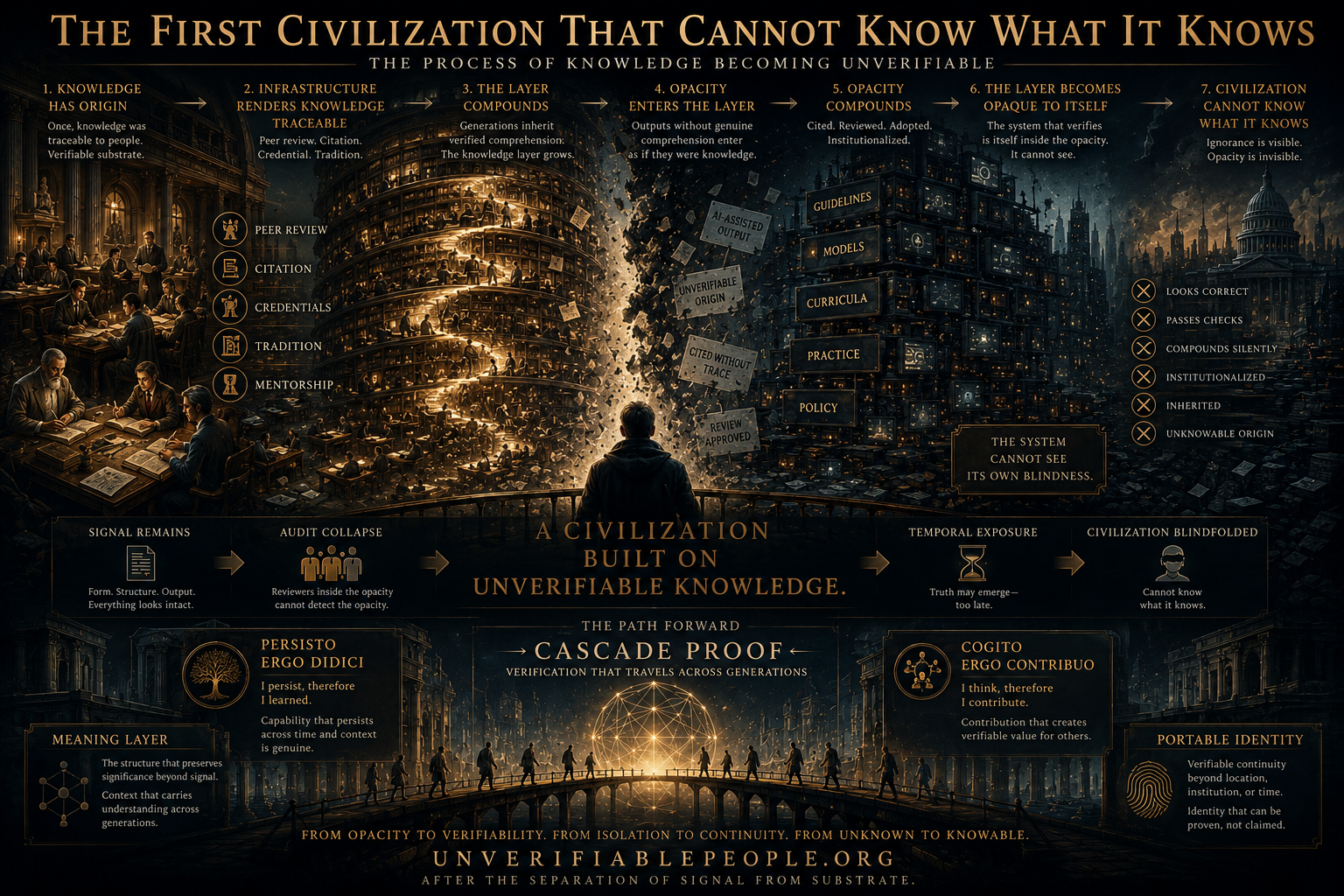
For the entirety of recorded history, civilization knew something it never needed to say: that the knowledge it held could be traced to the people who produced it.
Not as a policy. Not as a design principle anyone wrote down. As a structural feature of what knowledge was — a feature so foundational that no civilization ever needed to acknowledge it, because nothing had yet disrupted it. The physician’s understanding of pathophysiology could be traced to the physicians who developed it, the training they underwent, the cases they encountered, the teachers who challenged them. The engineer’s structural calculations could be traced to the education that produced them, the apprenticeships that tested them, the failures that refined them. The jurist’s reasoning could be traced to the tradition that formed it, the arguments that sharpened it, the minds that contested it.
Knowledge had an origin. The origin had a substrate. The substrate could be verified.
This was not a separate achievement of civilization. It was the condition civilization was built inside of — invisible because it was always present, foundational because everything else rested on it.
That condition is ending.
What Knowledge Actually Is
There is a distinction that civilization has always maintained without having to maintain it deliberately: the distinction between information and knowledge.
Information is everywhere. It has always been everywhere — in rumors, in records, in observation, in inference, in the vast accumulation of things that have been said and written and passed down. Information requires no verification of its origin. It circulates, accumulates, and compounds regardless of whether the human substrate that produced it possessed genuine understanding of what it describes.
Knowledge is different. Knowledge is information whose connection to reality has been established through the human substrate that produced it — through genuine encounter with the domain, through the structural comprehension that encounter deposits, through the capacity to reconstruct, extend, and defend the understanding when the original conditions are no longer present. Knowledge is not defined by its content. It is defined by its causal relationship to the comprehension that generated it.
This distinction sounds philosophical. It is entirely practical.
The distinction is what makes it meaningful to say that something is known rather than merely recorded. A proposition recorded by someone who did not understand it is information. The same proposition produced by someone who understood it, who could reconstruct it from first principles, who could navigate the adjacent territory the proposition opens — that is knowledge. The content may be identical. The epistemic status is categorically different.
Civilization’s entire infrastructure of expertise — its credentialing systems, its peer review mechanisms, its standards of evidence, its traditions of training and apprenticeship and supervised practice — was built to maintain this distinction at scale. Not because anyone designed it that way. Because every institution that tried to function on information alone eventually discovered that information without traceable comprehension behind it was not sufficient for the decisions that mattered.
The bridge required knowledge, not just structural data. The diagnosis required knowledge, not just symptom lists. The judgment required knowledge, not just legal precedent. The distinction between information and knowledge was the operational foundation of every domain where consequential decisions were made.
The Architecture of Knowable Knowledge
What civilization built, over millennia, was infrastructure for maintaining the connection between knowledge and its substrate at scale.
Peer review is not a bureaucratic process. It is a traceability mechanism — a system for ensuring that what enters the knowledge base of a discipline has been assessed by practitioners whose own comprehension of that discipline has itself been established through the same traceability infrastructure. The reviewer is credentialed. The credential was issued through supervised practice. The supervision was conducted by practitioners credentialed through the same process. The chain is long and imperfect, but it is a chain — a connected series of verifications that traces each addition to the knowledge base back to human substrate that has itself been verified.
Citation is not a courtesy convention. It is a provenance system — a mechanism for ensuring that every claim in a knowledge base can be traced to its originating source, which can itself be traced to the human substrate that produced it. The citation creates a path. The path can be followed. At the end of the path is a person, or a set of people, whose comprehension of the domain the claim describes was established through the traceability infrastructure of their time.
The credential is not a certificate of completion. It is a substrate attestation — an institutional claim that the human being holding it has undergone the process through which genuine structural comprehension of the relevant domain is developed. The credential is only as meaningful as the process behind it, and the process is only meaningful insofar as it actually develops the comprehension it claims to develop. But the infrastructure exists, and its purpose is clear: to ensure that the knowledge distributed under credentialed authority can be traced to human substrate that has genuinely encountered and internalized the domain.
All of this infrastructure — peer review, citation, credentialing, supervised practice, apprenticeship, the entire architecture of institutional expertise — was built to solve the same problem: how to maintain the distinction between information and knowledge at a scale that exceeds what direct personal verification can establish.
It worked because the Fabrication Threshold had not been crossed. Producing the outputs that this infrastructure was designed to assess — the peer-reviewed paper, the credentialed practitioner’s judgment, the expert’s analysis — required possessing the substrate those outputs were supposed to represent. The infrastructure measured the outputs and received the substrate as an inescapable companion.
The Compounding Layer
No generation inherits only information. Every generation inherits a knowledge base — an accumulated layer of verified human comprehension that has been built, tested, contested, refined, and certified through the traceability infrastructure of every preceding generation.
This inherited layer is civilization’s deepest asset. Not its technology, which can be replicated by anyone who understands it. Not its institutions, which can be rebuilt if their logic is understood. But its knowledge base — the accumulated, verified, substrate-traceable comprehension of every domain that civilization has constructed and maintained — is what makes it possible for any given generation to begin from where the previous generation ended, rather than starting again from nothing.
Every scientist who builds on established theory is inheriting verified substrate. Every physician who applies established clinical knowledge is inheriting verified substrate. Every jurist who reasons from established precedent is inheriting verified substrate. The inheritance is not passive. It is active — it is the foundation from which genuine new knowledge can be produced, because the foundation itself is solid, because the comprehension it represents can be traced, because the substrate behind it was real.
The compounding of knowledge across generations is not the compounding of information. It is the compounding of verified human comprehension — each generation adding to a layer that remains connected to the reality it describes, because the traceability infrastructure ensures that only verified substrate enters the layer.
When individual outputs become opaque — when the connection between signal and substrate becomes unverifiable at the level of the individual practitioner — the opacity does not remain at the individual level. It enters the layer. And once inside the layer, it compounds upward through every structure that the layer supports.
Opacity compounds not by hiding knowledge, but by imitating it perfectly.
The paper built on AI-assisted analysis that was never genuinely comprehended enters the knowledge base. It is cited. The citations enter the knowledge base. They are reviewed by practitioners whose own comprehension was formed in the same epistemic environment as the paper’s authors. The review passes the paper’s conclusions into the next layer. Guidelines are built on those conclusions. Practice is built on those guidelines. Training is built on that practice.
At each layer, the opacity that entered at the individual level has propagated upward — not as visible error, not as detectable misinformation, but as knowledge that looks exactly like knowledge, that passes every quality check the traceability infrastructure performs, that satisfies every criterion the review process applies.
The layer continues to grow. The opacity compounds within it. The two are indistinguishable from the outside — and increasingly, from the inside as well.
When the Layer Became Opaque to Itself
Previous civilizations faced a knowledge problem that was, in principle, solvable: ignorance. The knowledge base had gaps. The gaps were visible. The scientific program was, in its deepest structure, a systematic effort to identify the gaps — the places where understanding had not yet been established — and fill them through the process that produces verified substrate.
The problem that the Separation Event has introduced is categorically different. Not gaps in the knowledge base, but opacity within it. Not missing knowledge, but knowledge whose substrate has become unverifiable — knowledge that exists in the layer, that passes the traceability checks, that compounds upward through citation and review and credentialing, while the genuine comprehension it was supposed to represent may or may not be present behind it.
Ignorance has a shape. You can point to it. You can measure the distance between what is known and what needs to be known. You can direct resources toward filling the gap. Ignorance is the absence of knowledge, and absence, however large, is locatable.
Opacity has no shape. There is no empty space in the knowledge base that signals its presence.
Opacity is not the absence of knowledge; it is knowledge whose origin has disappeared. Ignorance limits a civilization; opacity misleads it.
The layer looks complete. The citations are present. The reviews were conducted. The credentials were issued. The guidelines were developed. The practice was established. Everything that the traceability infrastructure produces when knowledge is genuine is present — and the infrastructure has no mechanism for detecting when those outputs were produced without the substrate they were supposed to require.
This is not a statement about the intentions of the practitioners who contributed to the layer. It is a statement about the structural condition that the Separation Event created: a knowledge base that contains, in unknown proportion, verified substrate and opacity — and that cannot, using any instrument currently in standard use, determine which is which.
A civilization that cannot distinguish its knowledge from its opacity cannot know what it knows.
The Self-Reference Problem
The obvious response to this condition is more verification. Stronger peer review. More rigorous credentialing. Higher standards for the evidence required to enter the knowledge base. Better detection of the opacity that has already entered.
This response faces a structural problem that makes it insufficient on its own terms.
The instruments of verification are themselves part of the knowledge layer they are supposed to verify. The peer reviewers were trained through the same credentialing infrastructure that the Explanation Theater operating in educational settings has potentially already entered. Their structural comprehension of the domains they review was formed in the same epistemic environment as the authors whose work they assess. The standards they apply were developed by practitioners whose own formation was shaped by the same conditions.
Audit Collapse at the knowledge layer level means that the tools civilization has built to maintain the quality of its knowledge base are operated by the same generation whose formation may have introduced the opacity those tools are supposed to detect. The reviewer assesses the paper. The assessment requires the reviewer to possess genuine structural comprehension of the domain. The reviewer’s comprehension was formed through processes that the Fabrication Threshold has compromised in ways neither the reviewer nor the process that formed them can reliably detect.
The system that should stand outside the opacity and measure it is inside the opacity and cannot see it. Not because the system has failed. Because the system was built to verify knowledge whose substrate was traceable, and the condition that makes the substrate untraceable is the same condition that has formed the practitioners who operate the system.
There is a deeper layer to this self-reference that the standard framing of the problem tends to obscure. The problem is not only that the reviewers cannot detect the opacity in the work they assess. It is that the reviewers cannot assess their own assessment — cannot determine whether their judgment about what constitutes genuine comprehension in a given domain is itself grounded in genuine comprehension, or whether the Judgment Illusion that the same conditions have produced in other practitioners has also shaped their evaluative capacity. The tool that should detect the condition is itself potentially subject to the condition. Not certainly. Not verifiably. But structurally possible, in a way that no instrument currently in use can rule out.
This is not a counsel of despair. It is a precise description of why the solution cannot be more of the same instruments. The instruments are not inadequate versions of what is needed. They are accurate instruments for a world that has changed in ways they were not designed to detect. Adding more of them does not address the structural condition. It documents it more thoroughly.
What Everything Built on the Layer Inherits
Every structure that civilization has built on its knowledge base — its medical practice, its legal reasoning, its scientific consensus, its educational curricula, its policy frameworks, its engineering standards — inherits whatever the knowledge base actually contains.
When the knowledge base contained verified substrate, these structures inherited verified substrate. Their connection to reality was imperfect — it was always imperfect — but it was traceable. The error could be found. The gap could be located. The correction could be made, because the infrastructure that produced the knowledge was also the infrastructure that could identify where the knowledge had failed.
When the knowledge base contains opacity in unknown proportion, these structures inherit that opacity. Not visibly. Not in ways that trigger their own error-correction mechanisms. The medical guideline built on opaque research looks identical to the medical guideline built on verified comprehension. The legal doctrine built on opaque reasoning looks identical to the doctrine built on genuine structural understanding. The educational curriculum built on opaque expertise looks identical to the curriculum built on real knowledge.
There is a specific property of inherited opacity that makes it more consequential than inherited ignorance. Inherited ignorance is bounded: what is not known cannot be applied, cannot be built upon, cannot propagate through the structures that depend on the knowledge base. The gap constrains what can be done. Inherited opacity is unbounded: it is applied, built upon, and propagated through every downstream structure with the same confidence as verified knowledge, because the traceability infrastructure cannot distinguish between them. It does not constrain. It multiplies.
Each generation that builds on the layer without knowing what the layer contains passes the opacity forward, extended by whatever new opacity has been added during their own period of knowledge production. The inherited layer is larger in each generation. The proportion that is opacity versus verified substrate is unknown in each generation. And the unknowability itself compounds — because each generation’s tools for assessing the layer were formed in the same conditions as the layer they are assessing.
The structures continue. The practice continues. The training continues. The inheritance of opacity compounds silently through every downstream structure, in every generation that builds on the layer without knowing what the layer actually contains.
The Historical Position
Previous civilizations feared ignorance. They understood it as the enemy — the absence of knowledge that left them vulnerable to disease, to structural failure, to injustice, to the forces of nature that knowledge could predict and manage. The entire civilizational project of knowledge accumulation was, at its core, a response to this fear: build the knowledge base, extend it, protect it, pass it on.
The fear was productive. It generated the traceability infrastructure. It generated the institutions of expertise. It generated the scientific method, the legal tradition, the medical canon, the engineering standards. It generated, across millennia, the accumulated verified substrate that every subsequent generation inherited and built upon.
The condition now emerging is not ignorance. It does not look like what previous civilizations feared. The knowledge base is larger than it has ever been. The outputs it produces are more sophisticated than at any previous point in history. The institutions that maintain it are more numerous, more specialized, more interconnected than civilization has ever constructed.
What cannot be established — through any standard instrument currently in use — is what proportion of this knowledge base rests on verified human substrate, and what proportion consists of opacity that has entered the layer and compounded through it while passing every check the traceability infrastructure performs.
Tempus Probat Veritatem. Time proves truth. The temporal dimension of verification — the testing of knowledge against novel situations, across the passage of time, in conditions that were not present during its production — is the dimension that fabrication cannot replicate, because fabricated substrate does not persist under the conditions that genuine substrate survives. The knowledge that was produced without genuine comprehension eventually encounters the situation that exposes its opacity — the edge case, the novel application, the crisis that requires the structural model to be rebuilt from first principles.
But the exposure is slow. And it is uncertain. And by the time it arrives, the opacity that produced the failure has compounded through layers that will require careful, patient, substrate-verified work to rebuild.
Cascade Proof exists precisely because the individual-level verification that temporal persistence enables must eventually be aggregated into something that can assess the knowledge layer itself — the cryptographic verification of genuine capability cascades that distinguishes knowledge built on real substrate from knowledge built on opacity, through the patterns that only genuine consciousness-to-consciousness transfer produces across generations.
The danger is not that the layer contains falsehoods. It is that it contains truths without foundations.
Previous civilizations feared ignorance because ignorance was visible. The opacity now entering the knowledge layer is not visible. It passes every check. It compounds through every structure. It produces the same outputs as knowledge while the substrate behind it remains unknown.
A civilization cannot correct what it cannot distinguish from knowledge itself.
That is the condition. Not catastrophe. Not ignorance. Something that has no previous name in the history of human civilization:
A knowledge layer that has become opaque to itself.
UnverifiablePeople.org — After the Separation of Signal from Substrate.