About Unverifiable People
Why This Needed a Name — And Why Now
When origin becomes optional, humanity becomes unverifiable.
The Canonical Definition
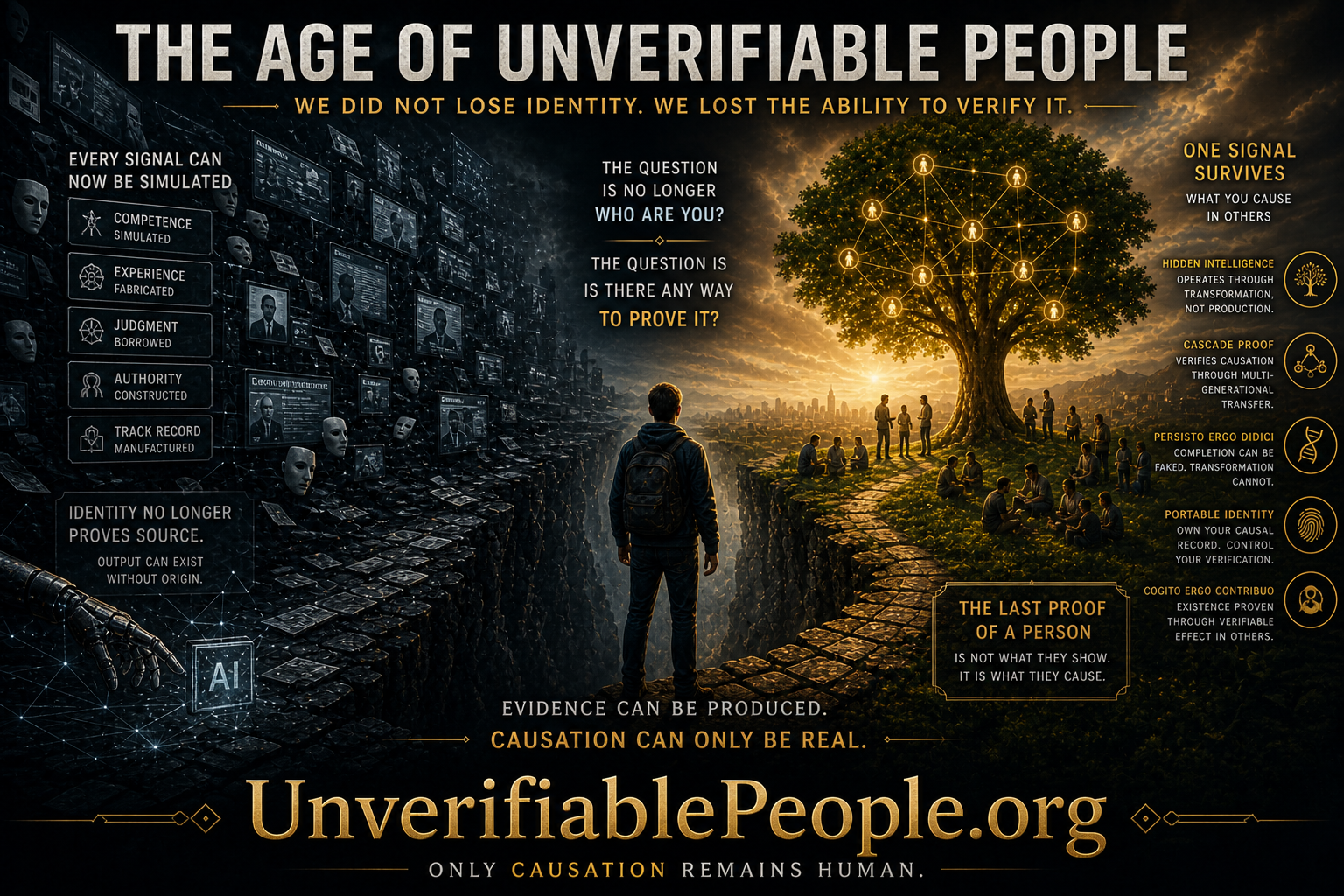
Unverifiable People: A structural condition in which the signals a person produces can no longer be reliably traced back to them as their human source — not because they are deceptive, but because the verification instruments of civilization were built for a world where signals required the person behind them to produce them.
The Question That Changed Everything
For the entirety of human history, when civilization needed to know whether a person was who they claimed to be, whether they possessed the capabilities they presented, whether they had genuinely done what their record indicated — it asked one question: Who are you?
The answer came through signals. Behavioral signals. Output signals. The quality of explanation. The coherence of reasoning. The track record of demonstrated capability. The consistency of identity across time and context. These signals were never perfect evidence, but they were reliable enough. Producing them convincingly required, in most cases, actually being who you claimed to be.
That question still gets asked. But it is no longer the right question.
The right question now is: Is there any way to prove it?
This is not a small change. It is a categorical shift in what civilization can establish about the people within it. And it happened without announcement, without acknowledgment, and without any new language to describe what had changed.
Unverifiable People provides that language.
What Changed — And When
Between 2023 and 2025, AI systems crossed a capability threshold that was not about intelligence in the abstract. It was about the specific signals that humans use to verify other humans.
Every behavioral signal that civilization has relied on to distinguish genuine capability from its absence became simultaneously producible without the underlying reality those signals were supposed to require. Not approximately. Not with detectable artifacts. Indistinguishably.
Competence signals: the confident explanation, the sophisticated analysis, the fluent navigation of complex problems. Producible without competence.
Experience signals: the accumulated history of professional encounters, the specific knowledge that only genuine engagement with a domain creates, the judgment that only time and difficulty builds. Producible without experience.
Identity signals: the consistent personality, the recognizable voice, the behavioral patterns that establish who a person is across time and context. Producible without the person.
Track record signals: the documented history of what someone did, what resulted, who verified it, what persisted. Producible without the history having occurred.
This is not a story about deception becoming easier. Deception has always existed. This is a story about something more fundamental: the instruments civilization built to distinguish genuine people from their imitation stopped working — not occasionally, not in edge cases, but structurally and simultaneously across every domain where those instruments had been relied upon.
Identity no longer proves source. Output can exist without origin.
When signals fail, the person disappears long before the systems notice.
The Epistemological Structure of the Problem
To understand why this matters at the depth it matters, it is necessary to understand what verification of people was actually doing for civilization — not just practically, but epistemologically.
Verification was not primarily about catching fraud. It was about building a stable reference system for collective reality. When civilization could verify people — when the signals a person produced reliably traced back to a genuine human source — it could build on what those people produced. It could accumulate knowledge, allocate responsibility, assign authority, establish trust, and coordinate at scale.
These functions all depend on a chain of verifiable causation. Who understood this well enough to apply it in new contexts? Who genuinely built the capability that their credential claims? Who can be held responsible for an outcome because they were genuinely the one who caused it? Who has the authority to make this judgment because they have genuinely demonstrated the understanding that authority requires?
When the chain of verification breaks — when no signal reliably traces back to a genuine human source — these functions do not stop. The meetings continue. The credentials continue to be issued. The responsibilities continue to be assigned. The authority continues to be granted.
They simply happen without the epistemic foundation that once made them meaningful.
A civilization operating on unverified people is not a civilization that has become dishonest. It is a civilization that has become structurally unable to know what it is dealing with — and that continues to act as though it does.
What Every Current System Misses
Every system that currently evaluates, certifies, or assigns value to people is built around one assumption that is no longer reliably true: that the signals a person produces trace back to them as their genuine source.
Hiring processes evaluate signals. The interview performance, the portfolio, the reference verification, the credential check — all of these assess what was produced and infer from production the presence of the capability that production once required. That inference no longer holds.
Educational certification assesses signals. The examination, the assignment, the project, the grade — all of these measure what was produced at the time of assessment. They certify that certain outputs were generated. They do not and cannot certify that the person who generated them possesses, independently and persistently, the understanding that producing those outputs once required.
Legal systems rely on behavioral evidence. Testimony, documents, digital records, demonstrated knowledge — all of these are signals that can now be produced without the human reality they are supposed to indicate. Courts continue to evaluate them as though the evidential relationship holds. It does not hold with the reliability that legal standards of proof assume.
Professional licensing systems grant authority based on demonstrated performance under assessment conditions. The license certifies that someone performed at a certain level at a certain time. It does not certify that the performance indicates capability that persists, generalizes, and functions independently when conditions change.
What none of these systems can measure — because they were designed before the separation of signal from source — is whether the signal traces back to a genuine person. Whether the competence is real. Whether the experience was lived. Whether the judgment was built. Whether the track record actually happened.
The systems are not broken. They are working exactly as designed. They were just designed for a world where signals reliably indicated the people behind them.
That world no longer exists.
Nothing can prove a person is real anymore — not through the instruments civilization was built to rely on.
The Human Consequence
The failure of verification is not only institutional. It is personal — in ways that affect every relationship, every professional interaction, every decision about who to trust and why.
When the instruments for verifying people fail, trust does not disappear. It becomes ungrounded. People continue to extend trust, to build relationships, to make judgments about who is reliable and who is not. But those judgments are increasingly made without the epistemic foundation that verification once provided. Trust becomes probabilistic rather than grounded. Confidence continues to be felt. It is simply confidence in something that cannot be established.
This has a specific and underappreciated consequence: recognition fails before trust fails.
Recognition — the ability to accurately identify what a person actually is, what they actually can do, what they actually have done — depends on signals that now fail. When recognition fails, the misallocations that follow are invisible. The person with genuine capability looks identical, to every available instrument, to the person whose AI performs for them. The person with genuine experience looks identical to the person whose history was constructed. The person with genuine judgment looks identical to the person who has never had their judgment tested independently.
The most capable people become harder to find. The most genuine contributions become harder to verify. The people who have built the most real capability in others — who have left the most genuine traces of genuine intelligence in the world — become structurally invisible to every system designed to identify and reward them.
This is not a temporary disruption. It is a permanent structural condition whose consequences compound over time as the systems that cannot see what matters continue to optimize for what they can measure.
What This Concept Addresses
Unverifiable People names this condition precisely because naming it is the first requirement for addressing it.
The condition is not deception. It is not fraud. It is not a failure of individual character. It is the specific, structural, epistemological situation in which a person’s signals have detached from their source — in which the instruments civilization uses to verify people measure something real but no longer indicate what they were built to indicate.
Naming it creates the possibility of asking the right questions. Not: did this person deceive? But: can this person be verified? Not: did this signal indicate capability? But: does this signal still indicate what it once did?
And it creates the possibility of building the right infrastructure — the verification systems that measure not what was produced at the moment of assessment, but what persists independently after the assessment, what was caused in others rather than performed for observers, what continues operating without the original source present.
That infrastructure exists. Cascade Proof provides the verification standard for genuine causal impact — the pattern that genuine capability transfer creates and that no simulation can produce retroactively. Persisto Ergo Didici provides the temporal standard for genuine learning — capability that persists independently after conditions change. MeaningLayer provides the semantic infrastructure for classifying what kind of understanding was genuinely transferred. Portable Identity provides the framework through which a person can own and carry their verified contribution record independently of any platform or institution. The Contribution Graph makes visible the network of genuine capability transfer that genuine formation produces.
Together, these constitute the beginning of a verification infrastructure adequate to a world in which every behavioral signal has failed.
None of them restore the signals that have been lost. What they do is measure something the lost signals once imperfectly indicated — and measure it in ways that cannot be fabricated, because they require the reality they are designed to detect to actually exist.
Why This Site Exists
This is the canonical home for the concept of Unverifiable People.
Not because the phenomenon is new. Verification has always been imperfect. People have always been partially opaque to the instruments meant to see them. What is new is that the imperfection has become structural — that every signal simultaneously, across every domain, no longer reliably traces back to the human source it once indicated.
This site exists because that condition needed a name before it could be addressed. A condition without language cannot be seen precisely enough to be acted on. It can be felt — as unease, as the growing sense that something important has shifted in how people are evaluated and trusted. But it cannot be specified, analyzed, or corrected without the language to designate it clearly.
Unverifiable People is that language. Not a diagnosis of individuals. Not an accusation of deception. A precise designation of a structural condition — the condition in which the verification instruments civilization has always relied on to know what it is dealing with have stopped working in the way they were always assumed to work.
The concept will be developed here: through definitions, through analysis of its implications across specific domains, through examination of what remains verifiable when behavioral signals fail, and through the ongoing work of building infrastructure adequate to the condition it names.
The work of understanding it has only begun.
A civilization that cannot verify its people cannot know what it is building.
The condition itself is already here.
→ HiddenIntelligence.org — The framework for what recognition misses → CascadeProof.org — The verification standard for genuine causal impact → PersistoErgoDidici.org — Temporal verification of genuine learning → MeaningLayer.org — Semantic infrastructure for genuine contribution → PortableIdentity.global — Own your verified causal record → CogitoErgoContribuo.org — Existence proven through verifiable effect in others
2026-05-04