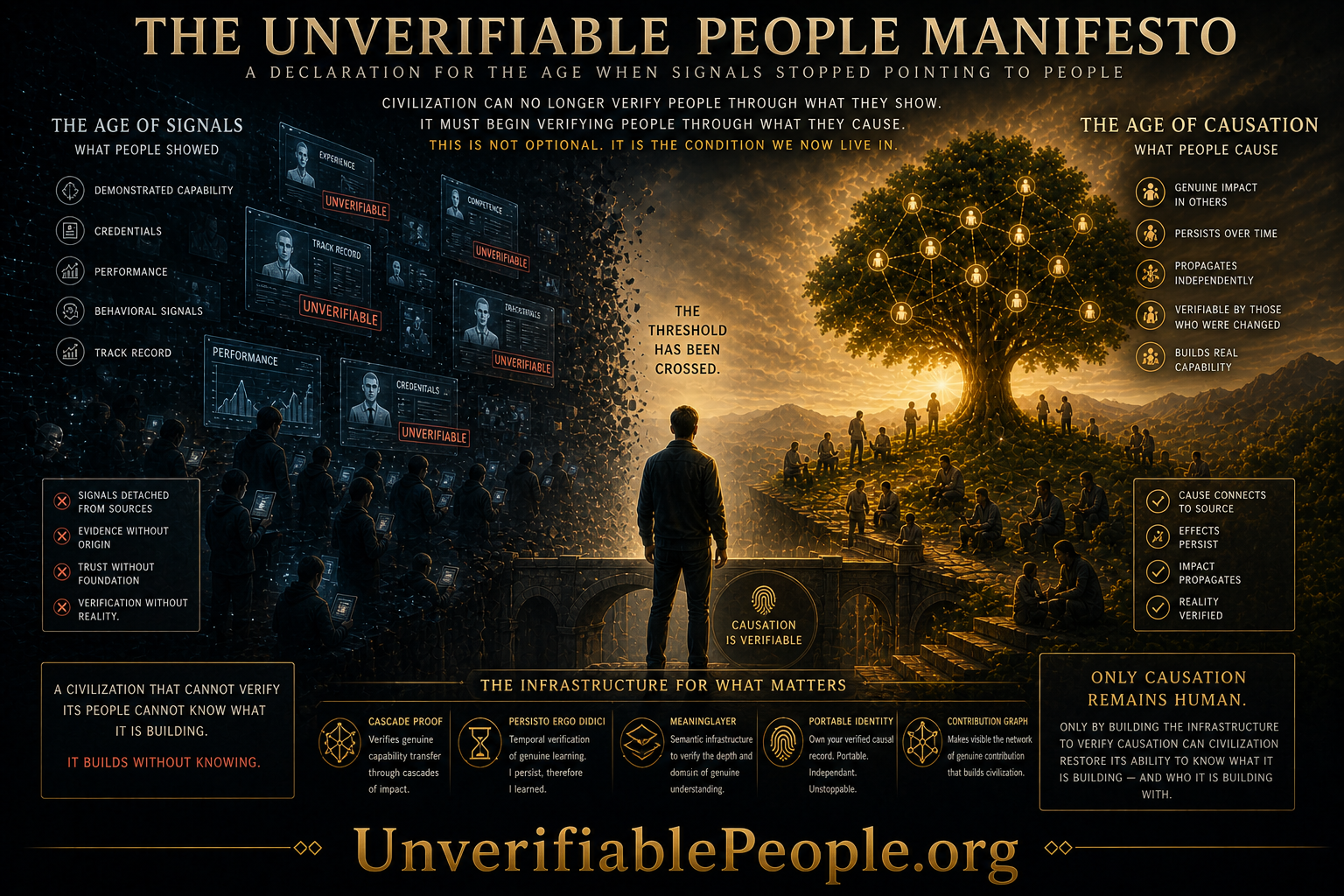
The Unverifiable People Manifesto
A declaration for the age when signals stopped pointing to people
Civilization can no longer verify people through what they show. It must begin verifying people through what they cause. This is not optional.
I. What Has Been Lost
We did not lose identity. We lost the ability to verify it.
This distinction is not rhetorical. It is the precise description of a structural change that has already occurred — and that most systems have not yet acknowledged, let alone addressed.
Identity still exists. People still are who they are. Competence still exists in those who genuinely built it. Experience still exists in those who genuinely lived it. Judgment still exists in those who genuinely developed it. What no longer exists is the reliable connection between what a person shows and what a person is.
The signals that civilization has always used to verify people — their demonstrated capability, their behavioral consistency, their track record, their professional performance — have detached from the sources they were supposed to indicate. They can now be produced without the underlying human reality they were designed to reveal.
This is not a technology problem. It is a verification collapse.
Every system civilization built to verify people — legal systems, employment systems, educational systems, professional licensing, social trust — was constructed on a single assumption that held for the entirety of human history: that the signals a person produced required the person to produce them. That assumption no longer holds. And every system built on it is now certifying, hiring, trusting, and allocating authority based on signals that may or may not trace back to the humans they are supposed to represent.
We are not facing a future risk. We are living inside the consequence of a threshold that has already been crossed.
II. What This Has Done to Civilization
When people cannot be verified, the effects do not arrive as a single visible failure. They arrive as a slow, structural drift — in every institution, every organization, every relationship that depends on knowing what it is actually dealing with.
Trust becomes untethered. Not absent — but floating. People continue to extend it. Institutions continue to grant it. But the epistemic foundation that once made trust an informed judgment rather than a probabilistic guess has eroded. What looks like trust is increasingly a performance of trust — a continuation of the forms of confidence without the substance those forms were supposed to express.
Accountability weakens. Not because people avoid it, but because the chain of causation — who did what, who genuinely understood what they were doing, who built what they claimed to have built — becomes harder to establish. When signals detach from sources, responsibility detaches from people. The systems that are supposed to assign accountability continue to function. They simply function on weaker ground than anyone acknowledges.
Recognition fails. The people who have genuinely built real capability — who have genuinely developed real judgment, genuinely accumulated real understanding through genuine encounter with genuine difficulty — become harder to find. Not because they are absent, but because the instruments for finding them are calibrated to detect signals that are now shared equally by those who optimized for appearance.
The most capable people become invisible. The most genuine contributions become unverifiable. The most important intelligence — the kind that builds genuine capability in others, that persists independently, that propagates through human networks in ways that cannot be manufactured — disappears from institutional view.
A civilization that cannot verify its people cannot know what it is building. It continues to build. It simply builds without knowing whether what it is building on is real.
III. What Is Not the Answer
The instinct, when verification fails, is to verify more.
More rigorous interviews. Stricter credential checks. More extensive background verification. Better fraud detection. More layers of identity confirmation. Mandatory AI disclosure. Detection algorithms. Behavioral biometrics. Expanded audit trails.
These responses are not wrong in intention. They are wrong in architecture. They all assume the instrument is functioning and needs to be more sensitive. The instrument is not malfunctioning. The instrument is measuring what it has always measured — signals — and the signals have lost their connection to the realities they were supposed to indicate. A more sensitive instrument pointed at the wrong thing does not produce better results. It produces more confident wrong results.
Consider what each of these responses actually does.
AI detection tools attempt to identify AI-generated content through observable properties — statistical patterns, linguistic markers, structural signatures. But the threshold crossing was defined precisely by the disappearance of detectable differences. There are no artifacts to find. The synthesis is indistinguishable not because the detection is insufficient but because indistinguishability is what achieving the threshold means. Improving detection of something that has been designed to be undetectable is not a solution. It is a category error.
Stricter documentation requirements assume that requiring more evidence restores the evidence’s connection to underlying reality. It does not. When signals are decoupled from sources, generating more signals is not difficult — it is trivially easy. Documentation requirements produce more documentation. They do not restore the relationship between documentation and the reality it is supposed to represent. They increase the volume of unverifiable evidence and certify it more thoroughly.
Expanded audit systems verify that the right processes were followed — that interviews were conducted, credentials were checked, references were contacted. None of this addresses whether the signals those processes evaluated still indicate the underlying realities they were designed to detect. A thoroughly audited hiring process that consistently selects people whose capability was produced rather than built is not a functioning hiring process. It is a well-documented failure.
Behavioral verification — monitoring how people work, how they communicate, how they solve problems over time — was once a meaningful supplement to point-in-time assessment. It is now subject to the same limitation. If AI assistance can produce indistinguishable outputs at the moment of assessment, it can produce indistinguishable outputs continuously. Behavioral observation that relies on the same signals that have failed provides no additional verification. It extends the window of observation without changing what is being observed.
The problem with all of these responses is structural, not superficial. They are attempts to restore the reliability of a verification method that has failed by applying it more carefully. The verification method has not failed because it was applied carelessly. It has failed because the world changed in a way that made it inadequate — permanently, structurally, irreversibly. Applying it more carefully does not change what it is measuring or restore its connection to the underlying reality it was once able to indicate.
The answer is not more verification of signals that have failed. The answer is verification of something else entirely — something that only genuine human reality produces and that cannot be fabricated regardless of how sophisticated the fabrication has become.
IV. What Must Replace It
What survives when every signal fails is causation.
Not what a person shows. What a person causes — in others, over time, independently of the conditions under which the capability was supposedly built. The pattern that genuine consciousness-to-consciousness interaction creates when it actually occurs. The pattern that no simulation can produce retroactively, because producing it requires the process it represents to have actually happened.
Genuine capability transfer has a structure that is distinct from information transfer, from AI-assisted performance, and from any form of output generation that does not involve genuine formation. When a person genuinely builds understanding in another person — not transfers information, not assists performance, but genuinely changes how someone thinks in ways that persist independently, generalize to novel situations, and propagate further through the people who were genuinely formed — the pattern that results is structurally distinguishable from anything else.
Information copies and degrades. Understanding compounds and propagates.
AI assistance improves performance in the moment. It cannot create capability that persists when the assistance is removed. It cannot create the cascade of genuine understanding moving independently through human networks, each node becoming genuinely more capable in ways that were not scripted or anticipated by anyone at the origin. The person who was genuinely formed becomes capable of genuinely forming others — without the original source, without assistance, in contexts the original interaction never anticipated.
This pattern is verifiable. Not through behavioral observation at a moment, but through the effects it creates over time.
Cascade Proof is the verification standard built on this principle. It does not assess what was produced at the moment of evaluation. It verifies whether genuine capability transfer occurred by measuring the pattern it creates: cryptographic attestation from beneficiaries whose capability genuinely increased, temporal persistence when conditions change and assistance is removed, independent propagation without the original source, exponential branching through human networks as each genuinely formed person forms others. This pattern cannot be fabricated retroactively. Either the formation happened and the effects exist in the world — in the people who were genuinely changed — or it did not. The cascade either exists or it does not. You cannot produce it on demand or generate it after the fact.
Persisto Ergo Didici — I persist, therefore I learned — establishes what genuine learning requires and what it does not. Completion is not learning. A process was completed. Performance is not formation. An output was produced. Genuine learning is capability that persists independently, without assistance, in genuinely novel conditions, after sufficient time has passed for borrowed performance to reveal its nature. The temporal standard is not arbitrary. It is the minimum required to distinguish formation from its imitation. Capability that collapses when conditions change was never capability. It was access.
MeaningLayer provides the semantic infrastructure for establishing what kind of understanding was genuinely transferred — distinguishing the information that expires from the understanding that compounds, classifying the depth and domain of genuine capability development, and making verifiable what kind of contribution actually occurred. Not all capability transfer is the same. Not all understanding is at the same depth. MeaningLayer makes these distinctions precise and verifiable rather than impressionistic and claimed.
Portable Identity provides the framework through which a person can own, carry, and present their verified record of genuine contribution — independently of any platform, institution, or employer that might otherwise control or erase it. This is not a minor technical feature. It is a civilizational requirement. In a world where the signals that established professional identity have failed, the only remaining record of genuine capability is the verified record of what a person genuinely caused in others. That record must belong to the person who created it — not to the institution that employed them when they created it, not to the platform that hosted the interactions in which it occurred. Your verified causal record is yours. No institutional change, no platform failure, no employment decision can sever you from the evidence of what you genuinely caused.
The Contribution Graph makes visible the network of genuine capability transfer — who genuinely enabled whom, in what domain, verified by the people who were genuinely changed, tracked across time in ways that distinguish genuine formation from dependency, genuine propagation from assisted performance. It makes the topology of genuine human intelligence visible — the cascades of understanding that move through human networks, building genuine capability at each node, in ways that no measurement system calibrated to observe individual performance at moments of assessment can see.
Together, these constitute a verification infrastructure adequate to the condition we are already in. Not by restoring the signals that have failed. By measuring what those signals once imperfectly indicated — the genuine causal presence of genuine human capability in the world — and measuring it in ways that require the underlying reality to exist.
Without this infrastructure, civilization will continue operating without knowing what is real. It will continue certifying, hiring, trusting, and allocating authority based on signals that no longer indicate what they claim to indicate — and the distance between what is certified and what is actually true will continue to widen, silently, until the consequences become impossible to attribute to anything specific because they have become the background condition of everything.
The longer this condition remains unaddressed, the further reality and recognition diverge.
V. What This Requires of Us
This manifesto is not a call to resist AI. AI is a powerful extension of human capability. The problem is not that AI exists. The problem is that we built our verification infrastructure for a world where AI did not, and we have not yet built the infrastructure adequate to the world where it does.
This manifesto is not a claim that human intelligence is superior to machine processing. In many domains, machine processing exceeds human capability and will continue to do so. The claim is different and more precise: that the specific pattern consciousness creates — genuine capability transfer that persists, propagates, and compounds through human networks — is both uniquely human and structurally unfakeable, and that civilization needs infrastructure to detect and verify it.
This manifesto is a declaration that the current situation is not acceptable as a permanent condition.
It is not acceptable that the most capable people are systematically invisible to every instrument designed to find them. It is not acceptable that credentials certify things they can no longer certify. It is not acceptable that organizations make consequential decisions about human capability based on signals whose connection to underlying reality has broken. It is not acceptable that individuals have no portable, verifiable record of what they genuinely caused in others — and must instead rely on institutional signals that have failed.
What this requires is practical, not utopian.
It requires that institutions begin asking different questions. Not: what did this person produce at the time of assessment? But: what persists in others because of genuine encounter with this person’s understanding?
It requires that credentials begin certifying different things. Not: did this person complete this process? But: does this person’s capability persist independently, generalize to genuinely novel situations, and function when conditions change?
It requires that individuals be given the infrastructure to own their genuine contribution — the verified record of what they genuinely caused, independent of any platform or institution, portable across every context in which it matters.
It requires building verification infrastructure that is adequate to the world as it actually is — not the world the old instruments were calibrated for.
VI. What Remains True
Verification of people is not a bureaucratic function. It is the epistemological foundation of civilization — the infrastructure through which institutions know what they are dealing with, individuals know who they can trust, and societies make choices grounded in reality rather than in its simulation. When that foundation fails, everything built on it continues to stand — until it encounters conditions that require the foundation to actually be there.
The signals civilization has relied on no longer prove what they claim to prove. Not occasionally. Not in edge cases. Structurally, simultaneously, across every domain where behavioral signals were the basis for verification. Continuing to treat those signals as reliable is not caution. It is the institutional equivalent of continuing to navigate by instruments that are known to be broken.
Genuine human intelligence — the kind that builds genuine capability in others, that persists independently, that propagates through human networks and cannot be manufactured — is real, irreplaceable, and currently invisible to every system designed to find it. Not because it has disappeared. Because the instruments were never calibrated to detect it directly, and the proxies that once pointed toward it have failed.
The people who have built the most genuine capability — who have genuinely developed real judgment through genuine encounter with genuine difficulty, who have genuinely changed how others think in ways that persist and propagate — are now systematically disadvantaged by every system that rewards the signals they share equally with people who never built what those signals are supposed to indicate.
This is not a temporary condition that will self-correct. It will not be resolved by better detection. It will not be resolved by more rigorous application of systems that were designed for a world that no longer exists. It will only be resolved by building systems designed for the world that does exist — systems that measure causation rather than performance, formation rather than completion, genuine effect rather than produced signal.
Causation is the only remaining basis for verification that survives the threshold that has been crossed. Not what a person shows. What a person causes. Not what a person performed. What a person genuinely built in others that continued without them. Not what was produced at the moment of assessment. What persists, propagates, and compounds in the world after the moment has passed.
A civilization that cannot verify its people cannot know what it is building.
Only causation remains human.
Only by building the infrastructure to verify causation — urgently and deliberately — can civilization regain its ability to orient itself in reality.
This is what Unverifiable People names. This is what must be built. And this is why it cannot wait.
This manifesto is maintained at UnverifiablePeople.org as part of the epistemological infrastructure for the age of unverifiable signals.
→ CascadeProof.org — The verification standard for genuine causal impact → PersistoErgoDidici.org — Temporal verification of genuine learning → MeaningLayer.org — Semantic infrastructure for genuine contribution → PortableIdentity.global — Own your verified causal record → HiddenIntelligence.org — The framework for what recognition misses → CogitoErgoContribuo.org — Existence proven through verifiable effect in others
UnverifiablePeople.org
2026