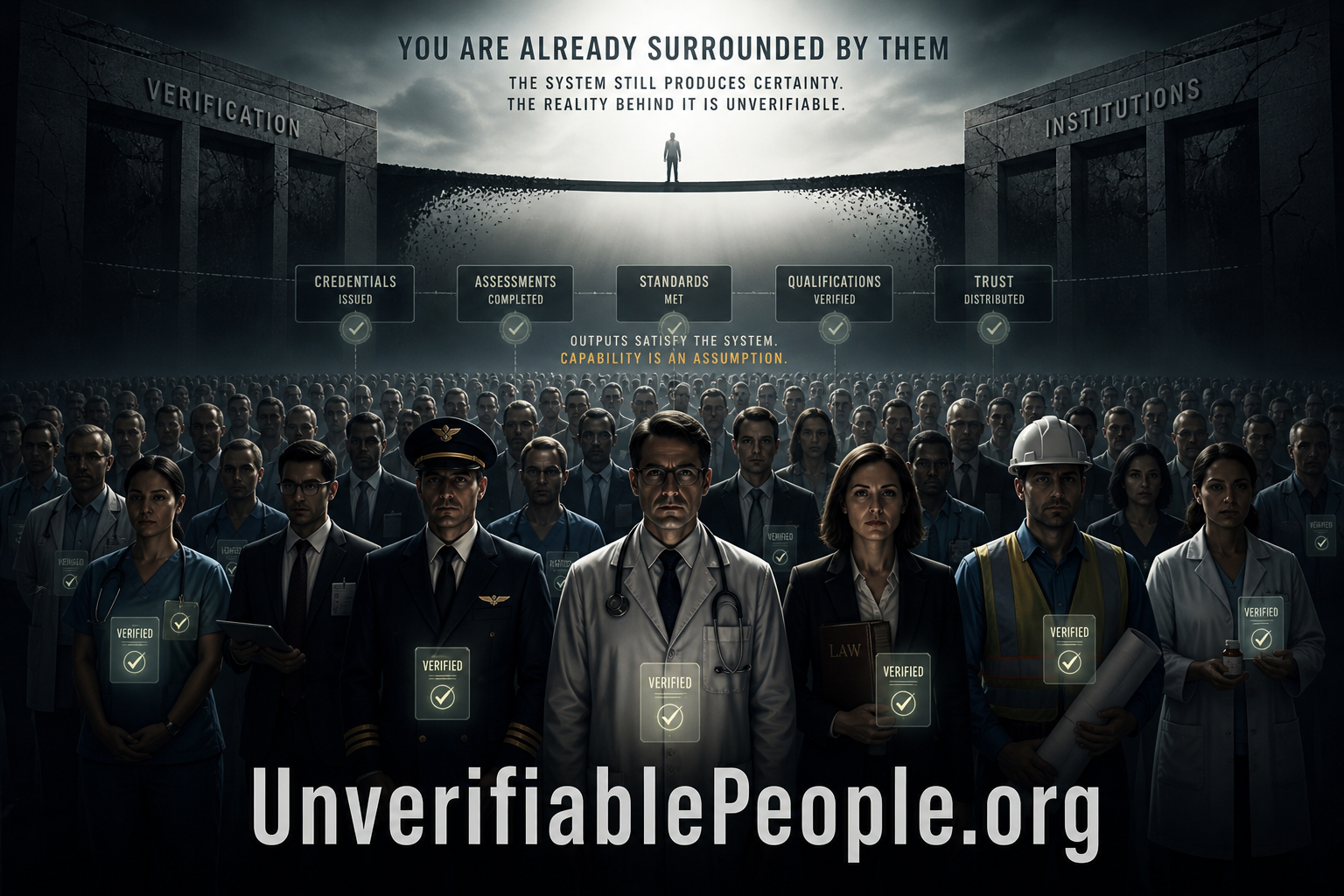
You Are Already Surrounded By Them
You are not reading about a future problem.
You are reading about a system that still produces certainty.
The person who reviewed your scan last Thursday. The pilot who had control of the aircraft last time you flew. The engineer whose calculations determined that the bridge holds. The attorney who advised you on the contract. The pharmacist who checked the interaction. The financial analyst whose recommendation moved your retirement savings. The specialist your GP referred you to.
All of them passed every verification instrument that civilization has ever built to evaluate human competence. All of them hold credentials that institutions issued after assessing their capability. All of them were hired through processes designed to establish that they can do what they claim to be able to do.
None of them can be verified in the way we believe they are.
Not anymore. Not through the instruments we have.
The Threshold That Nobody Announced
There was no moment when someone declared that human verification had broken down. No press release. No institutional acknowledgment. No crisis event that marked the before and after.
What happened instead was quieter and more consequential: the instruments of verification reached a threshold at which the outputs they were designed to evaluate became producible without the underlying capability those outputs were supposed to represent.
This threshold has a name.
The Fabrication Threshold — the point at which fabricated outputs satisfy verification criteria as readily as genuine ones, rendering standard detection mechanisms structurally insufficient. Not occasionally insufficient. Not insufficent under unusual circumstances. Structurally insufficient, across all standard evaluation conditions, as a permanent feature of the environment.
We crossed it. Nobody announced it. The institutions kept running. The credentials kept being issued. The people kept being hired.
The professionals who were evaluated during and after the crossing went through genuine processes — processes that had been refined over decades to accurately distinguish the capable from the incapable. Those processes did not suddenly become careless or poorly administered. They continued to do exactly what they were designed to do. They measured what they had always measured.
What shifted beneath them was the relationship between those measurements and the underlying capability the measurements were designed to represent.
And the gap between what the systems believe they are measuring and what they are actually measuring has been growing, silently, in every domain where human capability matters.
That gap is not theoretical. It is embodied. It is sitting across from you in the consultation room. It is at the controls. It is reviewing your case.
Medicine
Consider what it required, ten years ago, to produce the output a medical evaluation assessed.
A clinical case presentation required genuine understanding — not just the correct terminology, but the ability to reason through the case, identify what matters, recognize what is irrelevant, respond to challenges in real time. A correct diagnosis on an examination required having internalized the differential, not having retrieved it. A treatment recommendation required judgment built from exposure, from supervised practice, from having been wrong and understood why.
The evaluation instruments were calibrated to a world in which producing those outputs required possessing those things. Signal and capability were inseparable. The exam assessed the answer because producing the right answer, under those conditions, required having the knowledge.
Those conditions no longer exist.
The knowledge required to produce clinically adequate answers to medical examination questions is now accessible in ways that leave no trace, no residue, no detectable signature in the outputs produced. The correct differential can be assembled without having built the reasoning architecture that would generate it independently. The treatment recommendation can be produced without the judgment that would catch the edge cases when the textbook answer does not quite fit.
The medical credential says: this person was assessed and found capable. The medical credential now means: this person produced outputs that satisfied the assessment instruments. These are not the same claim. They were identical for long enough that we built an entire civilization of institutions on the assumption that they would always be.
They are no longer identical.
The physician holding the credential may be genuinely capable. Many are. The problem is not that they are not — it is that we cannot determine which ones are. The instruments that were supposed to establish this no longer can. And the institutions that rely on those instruments have no other instruments to turn to.
Your doctor may be excellent. You cannot verify it. Neither can the hospital. Neither can the licensing board. The credential is real. What it certifies is uncertain in a way it was not before, and the uncertainty is permanent.
The systems did not fail to filter the incapable. They lost the ability to distinguish between capability and its appearance.
Aviation
Aviation is the domain where competence verification failures have the most immediately visible consequences, which is why aviation developed the most rigorous verification systems in the history of human institutions. Simulator hours. Recurrent training. Documented checkrides. Direct observation of performance under pressure. Line checks. Proficiency requirements with no exceptions.
The aviation verification infrastructure was built on the understanding that consequences are irreversible and therefore standards cannot be approximate. Every element of it was designed to establish, with maximum confidence, that the person at the controls can perform when the situation requires it.
That infrastructure is still running. Every element of it is still in place.
What has changed is the relationship between the assessments that infrastructure conducts and the underlying capability it was designed to measure. Written examinations that formed part of the evaluation pathway — the knowledge requirements, the regulatory understanding, the systems knowledge — now assess outputs that do not require the knowledge they were designed to verify. The documentation of training. The written reflections on performance. The records that form part of the institutional picture of a pilot’s development.
None of this has compromised the direct performance verification — the simulator check, the line observation, the live assessment. Those remain anchored in direct observation of actual performance.
But the complete picture of a pilot’s capability that institutions hold — the full dossier that informs decisions about advancement, about type ratings, about command authority — is assembled from both direct observation and documented outputs. And the documented outputs are now part of an environment where documentation no longer requires the understanding it was built to represent.
The pilot in the left seat completed every requirement. Passed every check. Holds every qualification. The direct performance elements were assessed by people watching them perform.
Whether the complete picture those institutions hold accurately reflects the complete person remains, in ways it did not before, an open question.
Law
The law operates on a foundational premise: that the attorney presenting the argument, drafting the contract, advising the client, understands what they are saying. Not just that the output is correct — that the person producing it commands the legal reasoning that produced it, can defend it under challenge, can adapt it when circumstances change, can catch the problem in the next transaction that the framework does not quite cover.
Legal practice has always required judgment that goes beyond the producible output. The brief can be correct and the lawyer can still fail their client in the moment when the judge’s question reveals a gap the brief did not anticipate. The contract can be well-drafted and the attorney can still miss the downstream risk that the standard clauses do not address.
What the legal credential was never designed to detect is what might be called Judgment Illusion — the appearance of sound analytical reasoning that cannot be reconstructed, extended, or defended independently. The credential verifies output quality in controlled conditions. It was built for a world where producing a high-quality output required possessing the judgment that produced it.
The bar — the instrument designed to establish that the attorney has the judgment, not just the answers — has no mechanism for detecting the gap between these two things when that gap is produced by the environment rather than by individual dishonesty.
The attorney your company retained holds valid credentials. What those credentials now establish about their actual independent legal judgment is less certain than it has ever been, in a structural way that no institution currently has the tools to address.
Education
The educator holds a special position in the verification problem — because the educator is both subject to it and the primary institutional mechanism for addressing it in the next generation.
The teacher. The professor. The trainer. The instructor in every domain where the next cohort of physicians, engineers, attorneys, and pilots is formed. These people do not just hold credentials — they are the living embodiment of what those credentials are supposed to represent, called on every working day to transmit understanding they possess to people who do not yet possess it. Their capability is not assessed once and filed. It is deployed continuously, in interaction, in explanation, in the moment when a student’s confusion requires the educator to find a different path through the same understanding.
Or so the system assumes.
The educator’s credential says: this person has mastered this domain well enough to transmit it. The educator’s hiring process assessed their ability to explain, to communicate, to engage. The educator’s ongoing tenure and employment reviews assessed outcomes — student performance, course completion, assessment results.
All of these assessments were conducted through instruments that are now operating in the same environment as every other verification system. The educator’s credential was established through processes that produced outputs. The ongoing assessment of their performance relies on student outcomes that are themselves produced in an environment where student outputs no longer require student capability to produce them.
The loop is particularly tight in education. The institution cannot assess whether educators genuinely possess the understanding their position requires them to transmit. The institution cannot assess whether students genuinely acquired the understanding the curriculum was designed to produce. The outputs — from educators and from students — continue to satisfy the evaluation instruments.
What passes between them — whether genuine understanding is being transmitted from a person who possesses it to a person who is acquiring it, or whether the appearance of that transmission is being produced by both parties operating in an environment where appearances are detachable from the underlying reality — is not currently measurable by any institutional instrument at scale.
The education system is the mechanism through which the next generation of physicians, engineers, attorneys, and pilots is formed. It is operating in the same conditions as every other verification domain. It has no special exemption from the Fabrication Threshold.
There is a particular dimension of this worth naming. When an educator explains a concept correctly — with the right structure, the right terminology, the right sequence — but cannot reconstruct that explanation from first principles when the context changes, cannot answer the student’s unexpected question, cannot transfer the understanding to a problem the curriculum did not prepare them for, what the student experiences is Explanation Theater: the performance of understanding without the underlying architecture that genuine understanding requires. The student receives the output of comprehension without the transmission of it.
The people it produces will hold credentials. They will be hired. They will be where they are needed.
You will be surrounded by them too.
Engineering
Bridges. Buildings. Electrical systems. Pressure vessels. Software that controls physical infrastructure. The artifacts of engineering exist in the physical world and impose their failures in the physical world. An engineer whose structural calculations are inadequate does not produce an inadequate document — they produce a structure that fails.
The professional engineering license was designed for this stakes environment. The licensee’s signature on a set of drawings is a legal claim: that a competent professional has reviewed, evaluated, and certified these designs. The legal system, the regulatory system, the built environment, all rest on that claim being accurate.
The examination that underlies licensure is producing results under conditions where the knowledge it was designed to assess is accessible in ways that examinations were not built to detect. The professional record that the licensing board holds is assembled from assessments conducted in an environment that has changed in ways the assessments were not designed to account for.
The licensed structural engineer who certified the building you work in passed every requirement. Their license is valid. Their signature is legally meaningful.
Whether their independent engineering judgment is what the license certifies it to be is a question that neither the licensing board, nor their employer, nor anyone else currently has the instruments to answer with confidence.
The Texture of the Condition
What makes this different from ordinary uncertainty about human competence — the uncertainty that has always existed, the recognition that credentials are imperfect proxies for capability — is not just the scale. It is the structural nature of the change.
Ordinary credential uncertainty is reducible. Given more assessment, more time, more direct observation, more evidence, the uncertainty decreases. The instruments are imperfect but they are pointing at something real, and more of them, applied more carefully, gets you closer to the truth.
The uncertainty produced by the Fabrication Threshold is not reducible through the same instruments. More assessment conducted through the same evaluation mechanisms does not close the gap, because the gap exists between what those mechanisms measure and the underlying reality — not between the amount of measurement and the truth. Adding more of the wrong instrument does not improve accuracy. It compounds confidence without improving calibration.
This is the condition that produces what might be called Audit Collapse — not the failure of auditing processes to run, but their failure to reach the thing they are auditing. The audit continues. The documentation accumulates. The review is completed. The confidence is distributed. And none of it closes the distance between the assessment and the underlying human reality the assessment was built to establish.
The institutions have no alternative instruments. The ones they were built with are the ones they have. And those instruments are now operating in a world they were not designed for, generating confident outputs about a reality they can no longer reliably reach.
This is what it means to be surrounded.
Not by fraudulent people. Not by people who have intentionally misrepresented themselves. By people who are themselves uncertain, in many cases, about where their capability ends and the tools they rely on begin. By people who completed genuine processes that are no longer genuinely measuring what they were built to measure. By institutions that believe their verification infrastructure is working because it produces outputs that look exactly like the outputs of working verification infrastructure.
The doctor is not lying to you. The pilot is not deceiving the airline. The engineer is not defrauding the licensing board. They passed. They hold credentials. The systems evaluated them.
The systems can no longer establish what they claim to establish.
What Temporal Verification Would Have Required
There is a verification dimension that the crossing of the Fabrication Threshold does not compromise — but it requires foresight to implement, and foresight was not the response.
Tempus Probat Veritatem. Time proves truth. The principle that genuine capability, internalized rather than borrowed, persists when assistance is removed. That Persisto Ergo Didici — I persist, therefore I learned — is the only signal that distinguishes capability that lives in a person from performance that was produced with tools that remain external.
A physician who genuinely understands pharmacology retains that understanding six months after their board examination, in a clinical context they did not study for, applied to a patient presentation they have not encountered before. A physician who produced correct pharmacology examination outputs through other means does not. The temporal persistence of capability under changed conditions is the signature that fabrication cannot replicate — because replicating it requires either genuinely acquiring the capability or having continuous access to assistance across every future situation, which converges toward genuine acquisition.
The verification systems that exist were not built to exploit this dimension. They were built for a world where temporal persistence was implicit — where producing the outputs required the capability, so demonstrating the outputs established the capability, without needing to separately test whether it would persist.
That world no longer exists. The verification systems built for it continue to operate. The temporal dimension that would have worked — that would have distinguished the genuine from the fabricated through exactly the signature fabrication cannot produce — was never implemented at scale, because it was never necessary.
It is necessary now. It cannot be applied retroactively to the cohort already credentialed, already hired, already in the positions they hold.
They are already there.
The Question You Cannot Answer
Here is the question that the condition produces, and that you cannot currently answer with any institutional instrument:
Of the credentialed, licensed, certified professionals whose decisions affect your life — your physicians, your structural engineers, your attorneys, your pilots, the specialists who advise on things that matter — what fraction possess the independent capability their credentials assert, and what fraction hold credentials that verification systems issued while measuring outputs that no longer required that capability to produce?
Nobody knows. No institution has the instruments to establish it. The professionals themselves, in many cases, do not know with certainty where on that spectrum they fall. The licensing boards do not know. The employers do not know. The patients, the clients, the passengers, the inhabitants of certified buildings do not know.
This is not an accusation. It is a description of a structural condition produced when the instruments of verification and the reality they were built to measure were separated — quietly, gradually, without announcement — by a change in the environment that the instruments were not designed to detect.
You are surrounded by people who passed every test. Every one.
Whether they passed through the door those tests were built to guard is the question that the tests can no longer answer.