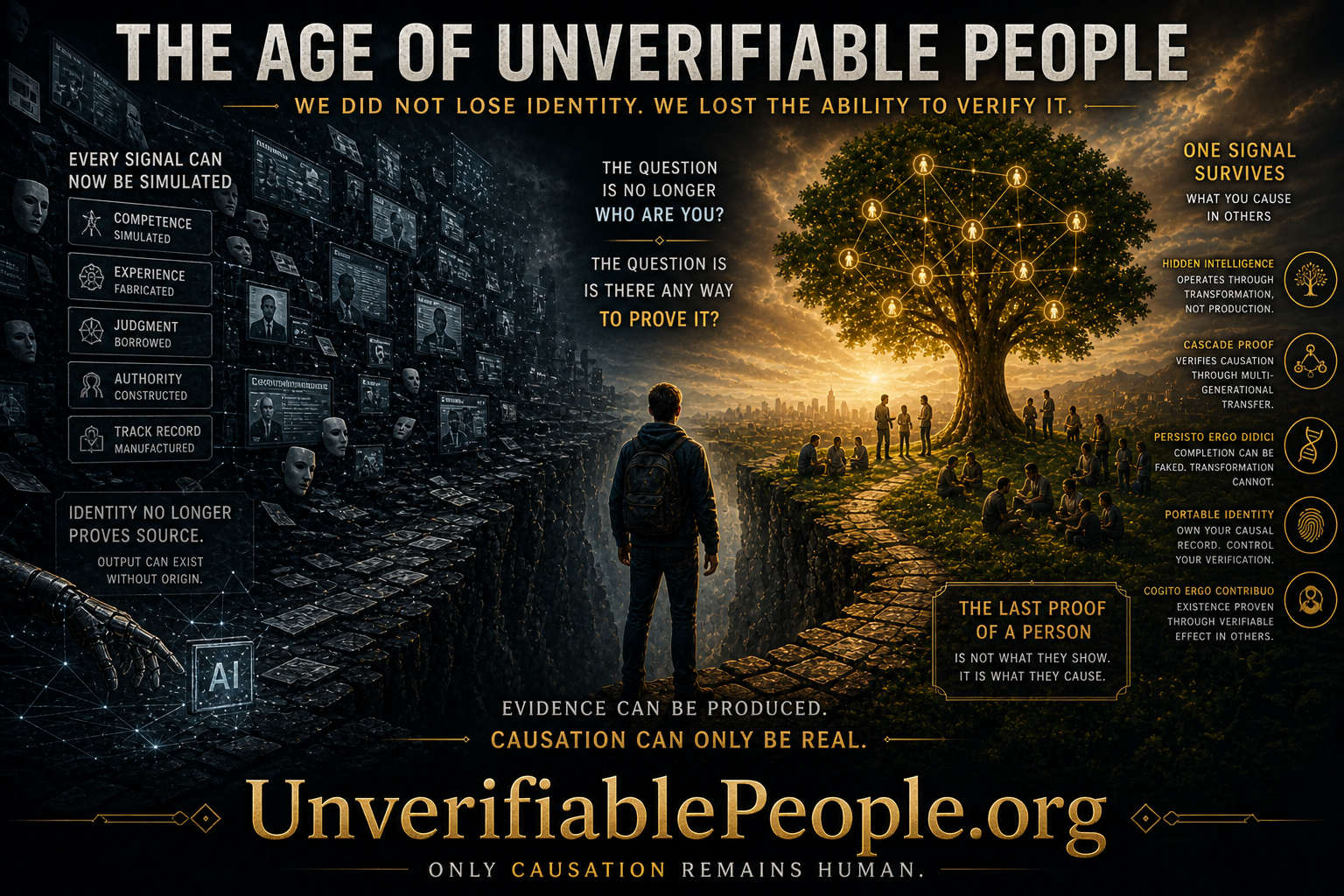
The Age of Unverifiable People
Only causation remains human.
We did not lose identity. We lost the ability to verify it.
TL;DR
For the entirety of human history, the signals that indicated a person — their reasoning, their expertise, their demonstrated capability — required the person behind them to exist. AI broke that requirement. Every signal civilization uses to verify people can now be produced without the human reality those signals were supposed to indicate. This is not a story about deception. It is a story about verification instruments that were built for a world that no longer exists.
The Canonical Definition
Unverifiable People: The condition in which a person’s signals — their competence, experience, judgment, and identity — can no longer be reliably traced back to them as their source, not because they are deceptive, but because the verification instruments of civilization were built for a world where signals required the person behind them to produce them.
An unverifiable person is not a fraud. Not a liar. Not someone concealing who they are.
An unverifiable person is someone whose signals — their competence, their experience, their judgment, their history, their voice — can no longer be reliably traced back to them as their source. Not because they fabricated anything. But because the instruments civilization uses to verify people were built for a world where signals required the person behind them to exist.
That world ended.
Why This Is Happening Now
For the entirety of human history, the signals that indicated a person — their reasoning, their expertise, their demonstrated capability, their behavioral consistency — were inseparable from the person producing them. You could not generate sophisticated professional judgment without having built it. You could not produce a convincing history of experience without having lived it. You could not demonstrate understanding without possessing it.
AI crossed a threshold between 2023 and 2025 that broke this connection permanently.
Every signal civilization uses to verify people — competence, experience, judgment, authority, track record, voice, personality — became simultaneously producible without the underlying human reality those signals were supposed to require. Not approximately. Not detectably. Indistinguishably.
The signals survived the separation from their sources.
This is not a story about deception becoming easier. It is a story about verification becoming structurally impossible through the instruments we have always relied on. The problem is not that people lie more. The problem is that truth and simulation now produce identical signals — and our instruments cannot tell them apart.
The Epistemological Rupture
When behavior no longer proves consciousness, when language no longer proves understanding, when history no longer proves experience, and when performance no longer proves capability — civilization faces a specific and unprecedented condition.
It can no longer verify people.
Not occasionally. Not in edge cases. Structurally, across every domain where human identity, competence, or contribution matters. The hiring process that once identified genuine capability now identifies whoever produces the most convincing signals of capability. The credential that once certified genuine understanding now certifies completion of a process that may have required no genuine understanding at all. The legal testimony that once indicated what a person knew or did can now be indistinguishable from what was generated.
The systems continue to function. The verifications continue to be issued. The conclusions continue to be drawn.
They are no longer connected to what they are supposed to verify.
Why This Needed a Name
A phenomenon that cannot be named cannot be seen. A phenomenon that cannot be seen cannot be addressed.
The specific condition in which a person’s signals have detached from their source — in which there is no reliable way to trace output back to a genuine human origin — had no precise designation before the conditions that created it existed at scale. It could be felt as unease, as a sense that something had shifted in how people were being evaluated and trusted. It could not be articulated precisely enough to act on.
Unverifiable People names the condition precisely: not the unverified, not the deceptive, not the fraudulent — but the structurally unverifiable. The person who may be entirely genuine, whose contribution may be entirely real, but who exists in a world where the instruments for establishing that genuineness have stopped working.
The name matters because what civilization needs now is not better detection of deception. It is new infrastructure for verification that does not depend on the signals that have failed.
What This Connects To
Unverifiable People does not stand alone as a concept. It is part of a larger recognition that the epistemological foundations of civilization — how we know what is real, who is genuine, what was actually caused by whom — have been simultaneously destabilized by the same threshold crossing.
Hidden Intelligence names what becomes invisible when recognition systems fail. Cascade Proof provides the verification infrastructure that survives when behavioral signals do not. Persisto Ergo Didici establishes what genuine learning looks like when completion no longer proves it. Cogito Ergo Contribuo reframes existence itself — from proof through thinking to proof through verifiable effect in others.
Unverifiable People is where the human consequence of these collapses becomes personal. It is not about systems failing in the abstract. It is about the specific person who cannot be known through any available instrument — and what that means for every relationship, institution, and decision that depends on knowing who someone actually is.
What This Changes Immediately
The condition of unverifiable people does not remain abstract. It changes how decisions are made, even when no one acknowledges it explicitly.
Trust becomes probabilistic rather than grounded. Not because people trust less, but because they no longer have a reliable way to verify what they are trusting. Every decision about a person carries an invisible uncertainty that cannot be reduced through better analysis of the same signals — because the signals themselves are what has failed.
Responsibility becomes harder to assign. When outcomes depend on capability that cannot be verified independently of the conditions that produced it, accountability weakens. Not because people avoid it, but because the connection between person and outcome becomes structurally harder to establish.
Authority becomes more fragile. The signals that once established expertise — clarity of explanation, confidence of reasoning, coherence of judgment — remain visible. But their connection to underlying capability is no longer reliable. Authority continues to be granted. It is simply granted on weaker ground than anyone acknowledges.
And recognition begins to fail. Not dramatically. Not visibly. But in the small, accumulating ways that shape who is trusted, who is chosen, who is listened to, and who is overlooked.
The unverifiable person is not the exception in this environment. They are the default condition. And a system that treats unverifiable people as if they were still verifiable does not collapse immediately. It continues to function — while gradually losing its connection to the reality it is supposed to be navigating.
What This Site Exists to Do
This is the canonical home for the concept of Unverifiable People — the definition, the analysis, the implications, and the developing body of work that examines what happens to civilization when people can no longer be verified through the signals that once made verification possible.
What This Site Will Develop
The concept of Unverifiable People will be developed here through definitions, articles, and analysis examining what happens across specific domains when people can no longer be verified through the signals civilization has relied on.
Coming areas of focus include: what unverifiability means for hiring and professional trust, how democratic accountability functions when behavioral evidence fails, what education certifies when completion no longer proves learning, and how relationships and identity navigate a world where every signal of personhood can be produced without the person.
The phenomenon is real. Its implications are still unfolding. This site exists to develop the language for understanding them.
What can be said now is this:
A civilization that cannot verify its people cannot reliably allocate trust, responsibility, expertise, or authority. It continues to do all of these things — but increasingly without the epistemic foundation that once made them meaningful.
Naming that condition is the first step toward building something that addresses it.
What cannot be verified cannot be trusted. What cannot be trusted cannot structure a civilization.
And we are now living inside that condition.
→ HiddenIntelligence.org — The framework for what recognition misses → CascadeProof.org — The verification standard that survives signal failure → CogitoErgoContribuo.org — The proof of existence built for this age