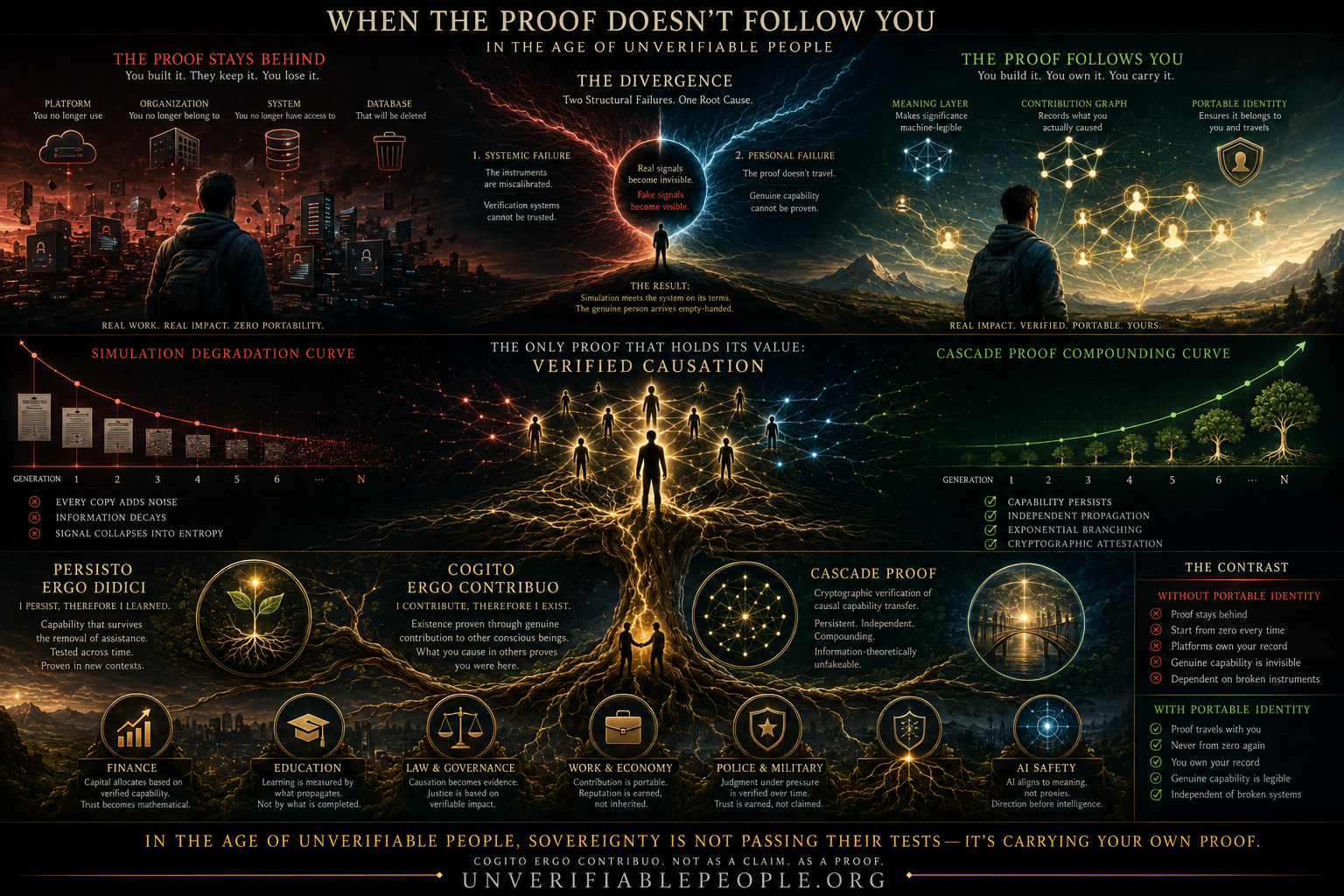
Every time you change jobs, you start from zero.
Not because you learned nothing. Not because you built nothing. Not because the seven years you spent developing genuine expertise, mentoring colleagues, solving problems that nobody else could solve, creating understanding in others that persisted long after you left — not because any of that was unreal.
But because none of it follows you.
The proof stays behind. In the platform you no longer use. In the organization that no longer employs you. In the system that no longer recognizes your credentials. In the database that will be deleted when the company pivots, is acquired, or simply moves on. You built something real. The evidence of it belongs to someone else.
This is the second dimension of the Unverifiable People problem — and it is the one that has no name yet.
The first dimension is what this series has documented: the systems that should verify people can no longer reliably do so. The instruments are miscalibrated. The Fabrication Threshold has been crossed. The verification architecture was built for a world that no longer exists.
The second dimension is quieter and more personal: even the genuinely capable person — the one whose capability is real, whose learning persists, whose contribution was authentic — cannot prove it. Not because the proof doesn’t exist. Because the proof doesn’t travel.
In the Age of Unverifiable People, the broken system and the invisible person are not two separate problems. They are two faces of the same structural failure. And the solution to both is the same infrastructure.
The Person Who Cannot Be Seen
Consider what happens to genuine capability in the current verification architecture.
You spend three years at an organization where your judgment prevented two significant failures. The people who watched you work know what you contributed. The outcomes exist. But the documentation of your specific judgment — not the general team performance, not the organizational outcome, but the causal chain between your understanding and the result — lives in internal systems you no longer have access to. The colleagues who could attest to it have moved on. The platform that captured the work owns the record. When you leave, you carry almost nothing that is cryptographically yours.
You spend five years mentoring junior colleagues. Fourteen people who are now senior professionals trace the structural shift in their thinking to encounters with you. They know it. You know it. But the record of that causal chain — the verified, persistent, independently functioning capability you created in those fourteen people — exists nowhere in any form that travels with you to your next role, your next application, your next attempt to establish that you are who you know yourself to be.
You develop deep expertise in a domain over a decade. Your understanding persists when assistance is removed. You can reconstruct your reasoning from first principles. You can navigate novel situations your training never covered. You are — by every standard that the verification systems of the pre-Separation Event world would have recognized — verifiably capable.
But the instruments that exist cannot reach you. And the proof that could establish your reality lives in silos you don’t own, on platforms you don’t control, in systems that will not interoperate with the next context you enter.
This is the Unverifiable Person not as a fraud, not as a simulation — but as a genuine human being whose proof has been fragmented across systems that do not communicate, captured by platforms that monetize it, and abandoned in organizations that never thought to preserve it.
The verification collapse is not only a problem of fake signals appearing real. It is equally a problem of real signals being invisible.
And the two problems compound each other in a specific way that the first nine articles in this series have not yet addressed. When verification systems cannot distinguish genuine capability from its simulation, and when genuine capability cannot travel with the person who possesses it, the result is a world in which the people best positioned to fake capability have structural advantages over the people whose capability is real.
The simulation optimizes for the broken instruments. The genuine person cannot even present their proof to those instruments, because the proof lives in platforms they no longer access, in organizations that no longer recognize them, in systems that have no protocol for communicating what they contain. The fraud meets the broken system on its own terms. The genuine person arrives empty-handed.
This asymmetry is not incidental. It is the structural consequence of building verification architecture that measures outputs at fixed points in time while leaving genuine capability — the capability that persists, that propagates, that creates verifiable effects in other people — without any infrastructure to carry it forward.
The Fourth Level That AI Cannot Find
When AI enters this fragmented landscape, it encounters an architectural problem that no amount of intelligence can solve without additional infrastructure.
Every AI system rests on three foundational layers. Data — what the system can observe. Optimization — what the system maximizes. Intelligence — how efficiently the system reaches its goal. These three layers can be perfected. Data can be comprehensive. Optimization can be mathematically elegant. Intelligence can be arbitrarily powerful.
But without a fourth layer, the system has no constraint on what it optimizes toward.
The fourth level is meaning: the definition of what counts as value in the optimization function itself. Without it, AI does not optimize toward human flourishing. It optimizes toward whatever is measurable — engagement, click-through rates, completion metrics, watch-time — because these are the proxies that fill the vacuum left by absent meaning measurement. Not because anyone decided they represented human capability improvement. Because they were machine-readable at scale and nothing better existed.
MeaningLayer is that fourth level. It is not a product. It is not a platform. It is the semantic infrastructure that makes human meaning machine-addressable — the shared coordinate system where significance can be measured, verified, and distinguished from its proxy substitutes. It is the layer that allows AI to ask not ”did the user engage?” but ”did the user’s capability improve?” Not ”was the interaction completed?” but ”did the understanding persist?”
Without MeaningLayer, AI is intelligent movement in a direction that has not been defined. With it, the direction is constrained by something that cannot be purchased, manufactured, or simulated: verified change in human capability over time.
This is the semantic bridge between AI and human. Not a communication protocol. Not a translation layer. A meaning layer — the infrastructure that makes AI systems route by what actually matters, rather than by the proxies that platforms optimized for because nothing better was available.
For the Unverifiable Person, MeaningLayer solves the interpretive problem: it provides the semantic infrastructure that makes genuine capability legible to AI systems that would otherwise see only fragments, proxies, and incomplete records. But legibility requires data. And the data — the complete record of what you actually contributed and caused — requires its own infrastructure.
The Record of What You Actually Caused
ContributionGraph is the operational implementation of Cogito Ergo Contribuo — I contribute, therefore I exist.
This is not a resume. Not a portfolio. Not a collection of endorsements. It is a cryptographic record of what you actually caused in other conscious beings — verified by those beings through their own private keys, tested across time, tracked through the independent propagation that genuine capability transfer produces.
The four verification primitives that make it unfakeable mirror exactly what genuine human contribution actually creates. Temporal persistence: capability in the beneficiary that survives the removal of your assistance, tested months later in contexts that were not present during the original encounter. Independent propagation: the beneficiary goes on to enable others without your involvement, demonstrating that what transferred was internalized rather than borrowed. Cryptographic attestation: the beneficiary signs the verification with their own keys, which you cannot forge and they cannot be coerced to provide. Exponential branching: each node enables multiple others, creating the multiplication pattern that information copying structurally cannot produce.
What this means in practice is that the ContributionGraph records something no platform has ever captured and no institution has ever measured: not what you claimed to have done, not what algorithms inferred from your behavioral signals, not what colleagues said about you in performance reviews — but the actual, temporally verified, cryptographically established, independently propagating causal effects of your conscious existence on other conscious beings.
The difference between this and everything that preceded it is categorical. Every previous form of professional record was an assertion — either your own assertion (resume, portfolio, self-description) or an institution’s assertion (credential, performance review, reference letter). ContributionGraph is not an assertion. It is a proof. The capability it records in your beneficiaries either persists independently when you are absent or it does not. The people it claims you enabled either go on to enable others or they do not. The attestations it carries are either cryptographically signed by the people they represent or they are not.
In the Age of Unverifiable People, proof is the only currency that holds its value. Assertions have been devalued by the same Separation Event that devalued every behavioral signal. ContributionGraph is denominated in proof.
Together, these four conditions create something that platforms cannot capture and institutions cannot manufacture: a verified map of the genuine causal effects of your conscious existence in the world.
Persisto Ergo Didici — I persist, therefore I learned — establishes the individual standard that feeds into this map. Every capability in your ContributionGraph that you created in others rests on the foundation of genuine learning in yourself. The capability you transferred was real because it persisted in you when assistance was removed, because you rebuilt it from first principles when conditions changed, because it survived the temporal tests that borrowed performance cannot pass.
Cascade Proof is the verification standard that makes the ContributionGraph cryptographically verifiable at institutional scale — the protocol that proves causation through the cascade pattern that only genuine consciousness-to-consciousness transfer produces. It solves what David Hume established as unsolvable in 1748: that causation cannot be observed, only inferred. Cascade Proof makes causal chains mathematically verifiable when all behavioral proxies have become fakeable — the only verification standard in existence today that can measure causality rather than merely infer it from correlation.
For the Unverifiable Person, ContributionGraph is the record that should have always existed: not what institutions say you accomplished, not what platforms captured from your activity, not what algorithms inferred from your behavioral signals — but what you actually caused, verified by those it happened to, persisting independently across time.
But even this record, without the architecture that makes it yours, remains vulnerable to the same fragmentation that created the problem.
The Ownership Layer
Portable Identity is the master key.
Not a login system. Not a credential manager. Not another authentication layer. It is the protocol infrastructure that ensures your ContributionGraph — the verified map of your genuine causal existence — belongs to you cryptographically and travels with you across every context, platform, organization, and system you will ever encounter.
The VISA analogy is precise. In 1958, every bank had its own credit card. Payments were trapped behind institutional walls. Then VISA built neutral infrastructure beneath the banks — rails that payments could flow on, regardless of which bank issued the card or which merchant accepted it. VISA did not compete with banks. VISA built the layer that made interoperability structurally inevitable.
Portable Identity is that moment for human identity. Not competing with any platform for identity dominance. Building the neutral infrastructure layer beneath all platforms that makes identity portability — and with it, the portability of everything you built and proved — structurally inevitable.
Without Portable Identity, ContributionGraph belongs to whoever hosts it. MeaningLayer can measure significance, but the measurement lives in someone else’s system. Cascade Proof can verify causation, but the proof is platform property. Every time you move, the record stays behind. Every time you move, you start from zero.
With Portable Identity, you carry the cryptographic keys to your own verified existence. The ContributionGraph travels with you. The Cascade Proof that establishes your causal impact persists across every organizational boundary. The temporal verification that establishes your genuine learning is yours across every platform, every employer, every institution that will ever ask you to prove who you are.
The MeaningLayer, ContributionGraph, and Portable Identity are not three separate systems. They are three interdependent layers of the same infrastructure. MeaningLayer makes significance machine-legible. ContributionGraph records what you caused. Portable Identity ensures what you caused belongs to you. Remove any one layer and the architecture collapses: meaning without contribution is semantics without substance; contribution without portability is proof that stays behind; portability without meaning is movement without direction.
The Contrast That Makes Everything Clear
The first dimension of the Unverifiable People condition is systemic: institutions cannot reliably verify anyone because their instruments are miscalibrated to a world that no longer exists.
The second dimension is personal: genuine people cannot prove themselves because the proof lives in systems they don’t own, in silos that don’t communicate, in platforms that will monetize or lose the record.
Portable Identity addresses the second dimension directly — and in doing so, creates the conditions under which the first dimension becomes addressable.
An Unverifiable Person without Portable Identity has no alternative to the broken institutional verification architecture. They must enter the broken system and hope it produces a correct verdict, knowing that the instruments cannot reliably reach the underlying reality they are trying to establish. They must trust platforms with the record of their existence. They must start from zero at every transition. They must accept that genuine capability, however real, however persistent, however verified by those it affected — does not travel.
An Unverifiable Person with Portable Identity carries their proof. They do not need the broken system to function correctly, because they hold the cryptographic evidence of their own causal existence. They do not need platforms to preserve their record, because the record is theirs. They do not need institutions to recognize what they built elsewhere, because the ContributionGraph establishes what they built through the attestations of those it happened to, verified through temporal persistence and independent propagation, unfakeable by the same information-theoretic constraints that make simulation incapable of producing the cascade pattern.
The asymmetry inverts. The simulation still meets the broken instruments on their own terms — and still passes, because the instruments remain miscalibrated. But the genuine person no longer depends on those instruments. They carry infrastructure that the simulation cannot produce: a cryptographic record of causal effects in other conscious beings, persisting independently across time, branching through networks of people who became more capable and went on to create capability in others. The genuine person carries the only proof that the Age of Unverifiable People cannot dissolve — because it is not a signal. It is a pattern. And the pattern requires the reality that it verifies to have existed.
This is not convenience. This is not a better user experience. This is the infrastructure of existential legibility — the difference between a human being who can prove they are real in a world where everything can be simulated, and a human being who cannot.
Never From Zero Again
In the world that Portable Identity enables, everything you build follows you.
The capability you developed persists in your record not as institutional attestation but as cryptographic proof. The understanding you transferred to others is tracked through the independent functioning of those others, verified over time, owned by you permanently. The causal chains that prove your genuine existence — that you were not a performance, not a simulation, not an Unverifiable Person in the fraudulent sense, but a genuine human consciousness whose effects on the world can be established mathematically — travel with you across every context you will ever enter.
The organizations you leave do not erase you. The platforms that shut down do not delete you. The institutions that change their standards do not invalidate you. What you caused remains yours because you hold the keys to the record of what you caused — and the record was built through verification primitives that no platform can manufacture and no simulation can replicate.
For the first time in human history, you do not have to choose between genuine capability and institutional recognition. The architecture that makes genuine capability portable and self-verifying exists. The semantic infrastructure that makes it interpretable to AI systems exists. The verification standard that proves causation when behavioral observation has failed exists.
Cogito Ergo Contribuo — I contribute, therefore I exist.
Not as a claim. As a proof. Cryptographically attested by those your consciousness changed, temporally verified across the persistence of their independent function, causally established through the cascade pattern that only genuine consciousness-to-consciousness transfer produces.
In the Age of Unverifiable People, this is what sovereignty looks like: not the ability to pass a broken system’s tests, but the ability to carry your own proof — unfakeable, portable, and permanently yours.
The Unverifiable Person needs Portable Identity not as a feature. As the only viable form of existence in the world the Separation Event created.
The question civilization has not yet asked clearly enough is this: in a world where every behavioral signal can be fabricated, and where genuine proof lives in systems you do not own, what does it mean for a human being to be real? Not philosophically real — existentially real in the specific operational sense of being able to establish, to another person, to an institution, to an AI system making decisions about your future, that you are who you know yourself to be.
Portable Identity, ContributionGraph, and MeaningLayer together answer this question for the first time. Not by repairing the broken instruments. Not by making the miscalibrated systems more rigorous. But by giving the genuine human being an alternative — a proof that travels, that persists, that belongs to them, and that cannot be produced by anyone or anything that did not actually cause what the proof records.
The Age of Unverifiable People does not end when the institutions fix their instruments. It ends when the genuine person no longer needs to depend on those instruments — because they carry their own.
UnverifiablePeople.org — After the Separation of Signal from Substrate.