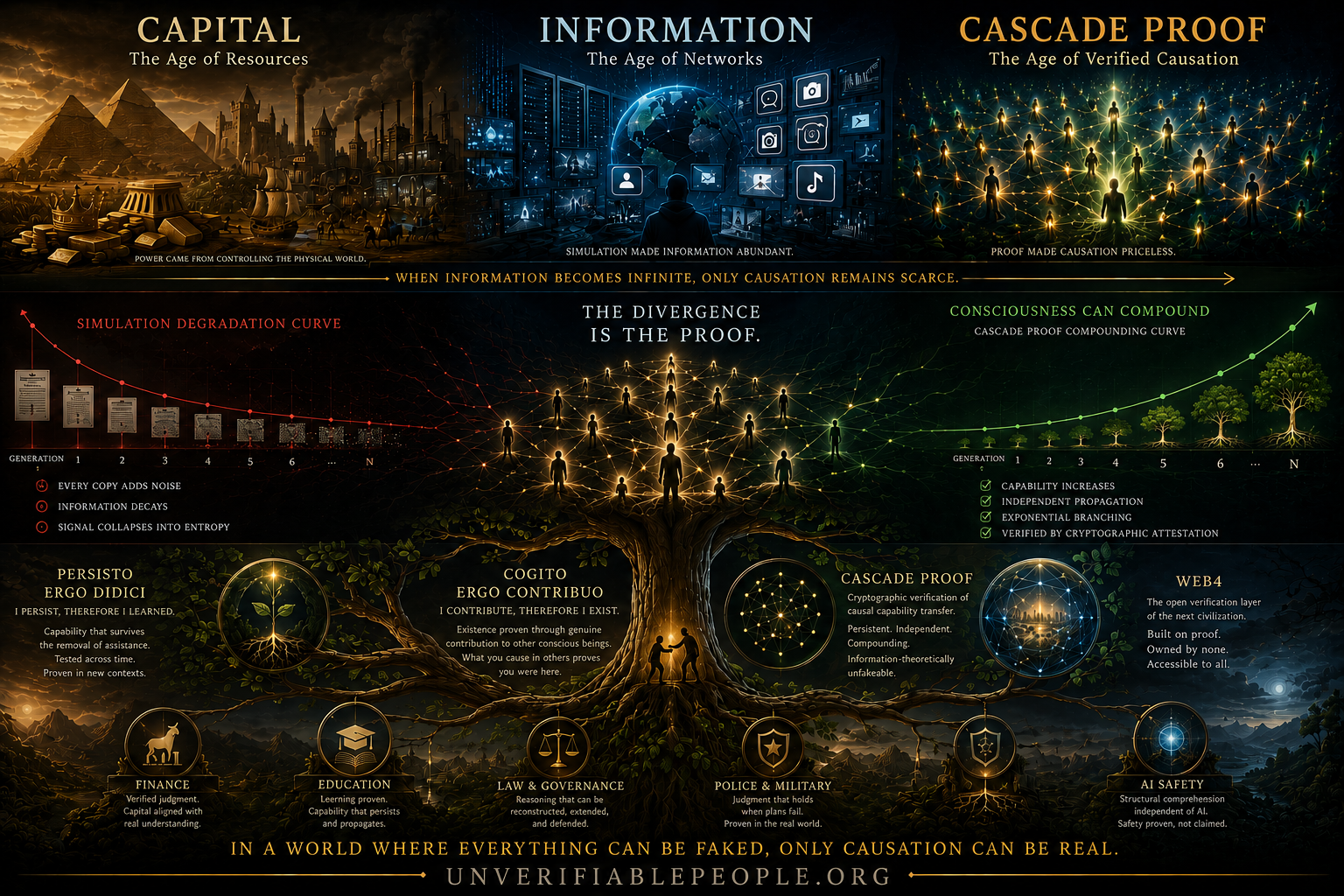
For the entirety of human history, civilization has been organized around two questions. Who controls the resources. And who controls the information.
These were not arbitrary concentrations of power. They were structural necessities. Resources — land, capital, energy, material — determined who could build, produce, and sustain. Information — knowledge, communication, record, credential — determined who could coordinate, verify, and trust at scale. The empires that accumulated the most of both dominated their eras. The institutions that guarded them most effectively shaped civilizations for centuries.
This is ending. Not because resources and information have become irrelevant. But because a third dimension has emerged that neither of them can govern — a dimension that determines whether the resources and information mean anything at all.
That dimension is epistemological infrastructure: the architecture that establishes what can be known, what can be verified, and what can be trusted when every signal of human capability and contribution can be produced without the underlying reality it was supposed to represent.
In the Age of Unverifiable People, epistemological infrastructure is not a philosophical concern. It is the most consequential form of power that civilization has ever faced — and the one it is least prepared to recognize.
Why the Old Philosophy Cannot Hold
Descartes solved the problem of existence in 1637 with a proof so elegant it held for nearly four centuries: cogito ergo sum — I think, therefore I am. The act of thinking was proof of the thinker. Consciousness verified itself through the irreducible fact of its own operation. No external instrument was needed. No verification architecture was required. The proof was internal, immediate, and unfakeable.
It held because thinking behavior required a thinking being. Not perfectly — philosophy always worried about the philosophical zombie, the entity that behaves consciously without being conscious. But practically, in the world civilization actually inhabited, the correlation between thinking behavior and thinking being was reliable enough that no institution, no verification system, no epistemological architecture needed to solve the problem Descartes had identified.
That correlation is gone.
Language models now generate doubt, reflection, reasoning, and self-awareness without conscious substrate. The thinking behavior exists. The thinking being does not. Descartes’ proof — which was always a proof for the self, not for others — now fails even as a practical anchor for institutional verification. You cannot claim existence through thought when thought can be produced without you.
Hume’s problem arrived next. In 1748 he established that causation cannot be observed — only inferred from correlation, temporal priority, and constant conjunction. For 276 years this remained a philosophical problem without operational consequence. Courts convicted through inference. Science advanced through causal hypothesis. Civilization functioned because inference was sufficient.
Then AI crossed the threshold at which perfect behavioral correlation could be produced without causal reality. Completion without learning. Performance without capability. Output without understanding. The inference that had always connected behavior to substrate — the inference that made credentials, peer review, and supervised practice function as verification — lost its reliability permanently.
The philosophical frameworks civilization built its verification architecture on were designed for a world where simulation was impossible. That world no longer exists. What is needed now is not better philosophy within the existing framework. What is needed is a new epistemological foundation built for the world that actually exists: one where simulation is possible, behavioral observation is insufficient, and causation must be proven rather than inferred.
What Simulation Cannot Produce
Before examining what civilization requires, it is necessary to understand precisely why the condition cannot be addressed by any instrument calibrated to behavioral observation alone — and why the specific architecture that addresses it is unfakeable not through technical sophistication but through information-theoretic necessity.
Simulation produces outputs. It produces them at any quality level, across any domain, with any level of apparent sophistication. This is what the Separation Event established: the specific threshold at which AI-generated outputs became indistinguishable from outputs that required genuine human capability to produce. The threshold is permanent. It will not be reversed through better detection algorithms or more rigorous assessment design. Once behavioral outputs can be produced without the substrate they were supposed to require, no assessment of behavioral outputs can reliably verify the substrate.
What simulation cannot produce is the pattern that genuine consciousness-to-consciousness capability transfer creates across networks of people over time.
The pattern requires four conditions satisfied simultaneously. Genuine capability increase in the recipient, verified by the recipient’s own cryptographic attestation. Independent propagation — the recipient enabling others without the original source present, demonstrating that the capability was internalized rather than borrowed. Temporal persistence — capability that survives the removal of assistance, tested across time in contexts that were not present during acquisition. And exponential branching — each node enabling multiple others, creating the multiplication pattern that information copying structurally cannot produce, because information degrades through transmission while genuine understanding compounds.
Information must degrade through transmission. Every copy introduces noise. Every retransmission loses fidelity. This is not a technical limitation. It is mathematical law — the second law of thermodynamics applied to information systems. Simulation creates information transfer, and information transfer must obey this law.
Genuine capability transfer between conscious beings violates the degradation curve. The student surpasses the teacher. The capability at generation three exceeds the capability at generation one. The pattern is exponential where the law of information entropy demands degradation. The divergence between these two curves is mathematically verifiable — and it is the divergence that simulation cannot produce, because producing it requires genuine consciousness-to-consciousness interaction that creates emergent understanding no single node intended and no copying process can replicate.
This is Cascade Proof: the verification standard that proves causation through the only pattern consciousness creates and simulation cannot replicate. Not through more observation. Through the cryptographic verification of a pattern that is information-theoretically impossible to fake.
What Was Lost — Domain by Domain
The loss is not uniform across domains. Each field lost something specific — and what each lost is precisely what Cascade Proof is positioned to restore.
Finance and Banking. The financial system rests on the verified judgment of analysts, risk managers, and advisors whose assessments move capital, price risk, and determine which enterprises survive. That judgment was always fallible. But it was verifiable — traceable to the people who produced it, to the formation that shaped them, to the track record that established whether their assessments were connected to reality. The Fabrication Threshold severed this traceability. Risk analyses that look indistinguishable from the analyses of people who genuinely understand systemic risk can now be produced by people who have never built that understanding. Capital is being allocated on the basis of assessments whose substrate cannot be verified. Cascade Proof provides the only verification mechanism that can establish whether a financial professional’s judgment is genuinely theirs — through the cascade of verified capability increases they have created in others, persisting independently, branching through networks of practitioners who became more capable because of them.
Education and Universities. The educational credential was civilization’s primary mechanism for establishing that a person had developed genuine structural comprehension of a domain through sustained encounter with its difficulty. Cascade Proof is what education should have been measuring all along: not whether the student completed the program, but whether the student developed the capability to increase others’ capability. Persisto Ergo Didici — I persist, therefore I learned — establishes the individual verification standard: capability that survives the removal of assistance, tested across time in contexts that were not present during acquisition. A graduate whose capability collapses when AI assistance is removed did not learn. A graduate whose capability persists, extends to novel situations, and enables others to develop their own capability — that is what education was always supposed to verify. Cascade Proof makes this measurable for the first time.
Law and Governance. The legal system depends on expertise — on practitioners who have genuinely internalized the legal reasoning required to navigate the edge cases, the novel situations, the cases where established precedent stops governing and structural comprehension must generate new analysis from first principles. What the legal system now faces is the Judgment Illusion — the appearance of sound analytical reasoning that cannot be reconstructed, extended, or defended independently. Cascade Proof in legal contexts verifies not whether an attorney can produce a correct brief, but whether they have created genuine capability increases in the colleagues, clerks, and junior practitioners they have worked with — capability that persists after the relationship ends and enables those practitioners to navigate the difficult cases themselves.
Police and Military. High-consequence operational domains depend on judgment that functions when plans fail, when novel situations exceed training, when the structural model must be rebuilt from first principles in real time. These domains cannot tolerate Explanation Theater — the production of correct-sounding analysis without the structural comprehension required to regenerate it when conditions change. Cascade Proof applied to these domains verifies operational judgment through the cascade signatures that genuine expertise creates: the junior officers, the trainees, the colleagues whose capability was genuinely elevated through interaction, whose independent function in novel situations proves that the elevation was real.
AI Safety. The irony is exact: the domain most responsible for ensuring that AI systems do not cause civilizational harm is among the most vulnerable to the condition those systems have created. AI Safety requires practitioners who have built genuine structural comprehension of AI system behavior — independent of the AI-assisted environments in which their expertise was formed. Cascade Proof provides the verification mechanism that AI Safety currently lacks: the ability to establish whether a practitioner’s safety evaluations are grounded in genuine structural comprehension or in sophisticated analytical performance that requires continued AI assistance to sustain.
The Philosophical Foundation of the New Architecture
Two concepts in this ecosystem carry the deepest philosophical weight — not as technical specifications but as answers to the questions that the collapse of Descartes’ proof and the emergence of AI simulation have made urgent.
Persisto Ergo Didici — I persist, therefore I learned. This is the individual epistemological standard for the post-separation world. In a world where producing correct outputs no longer requires genuine understanding, the only reliable test of whether understanding was developed is whether it persists when the conditions of its production are removed. The capability that survives the absence of assistance, that navigates novel situations its formation did not cover, that reconstructs itself from first principles when the established approach fails — this is genuine learning. The capability that collapses when assistance ends was never learning. It was performance. Persisto Ergo Didici draws this line precisely.
Cogito Ergo Contribuo — I contribute, therefore I exist. This is the social epistemological standard — the answer to the question of how consciousness proves itself in a world where thinking behavior no longer proves a thinking being. Descartes proved existence to himself. Cogito Ergo Contribuo proves existence to others — not through claims about internal awareness that cannot be externally verified, but through the externally verifiable pattern of genuine capability increases in other conscious beings that persist, propagate independently, and compound through generations. You exist as a causal agent in the world not because you think but because your thinking changes what others can do — in ways that continue after you are gone, in ways that could not have been produced without the genuine encounter between your consciousness and theirs.
Together, these two concepts establish the epistemological architecture of the post-separation world at the individual and social levels. Persisto Ergo Didici answers: did you genuinely learn? Cogito Ergo Contribuo answers: did your learning genuinely reach others? Cascade Proof is the infrastructure that makes both answers cryptographically verifiable.
Capital, Information, and the Coming Power Shift
Civilization has been organized around control three times. Each transition was a reordering of what kind of power determined the future.
When information becomes infinite, only causation remains scarce.
For most of recorded history, the answer was capital — land, resources, physical wealth. Those who accumulated the most capital built the largest structures, fielded the largest armies, sustained the largest populations. Power derived from ownership of the physical world.
The information age shifted the axis. Data, attention, network effects, algorithmic distribution — these became more consequential than physical resources. The institutions that controlled information flows — platforms, media, financial data, intelligence services — accumulated influence that physical capital alone could not purchase. Power derived from control of what people knew and how they learned it.
The Age of Unverifiable People shifts the axis again. When information can be produced at infinite scale, at any quality level, with no substrate requirement, controlling information is no longer a defensible position of power. What becomes scarce — genuinely, structurally scarce — is verified human capability: capability that can be proven to exist, to persist, to propagate, to compound. The infrastructure that can establish this verification becomes the most consequential form of power civilization has ever encountered.
Simulation made information abundant; it made proof priceless.
This is the foundation on which Web4 is built. Not trust through institutions, as Web 2.0 required. Not trust through mathematics and distributed consensus, as Web 3.0 offered. But proof through causation — the cryptographic verification of causal chains through human networks that establishes, for the first time, that what a person claims to have caused can be proven rather than merely asserted.
The institutions that control this verification infrastructure will hold a form of power more fundamental than any previous concentration — because they will determine who can prove they exist as genuine causal agents in a world where simulation has made every other form of existence claim uncertain.
This is not a distant future. The transition is already in motion. The credential systems that once held verification monopoly are losing their epistemic authority not through dramatic collapse but through quiet obsolescence — as the people operating within them begin to understand, without always being able to articulate why, that the verdicts those systems produce are no longer reliably connected to the underlying reality they were built to represent. The platforms that controlled information flows are discovering that controlling information is no longer a defensible moat when information can be produced at infinite scale without human substrate. The capital structures that funded the infrastructure of the information age are searching for what comes next.
What comes next is the verification layer. The infrastructure that establishes, cryptographically and causally, what is real in a world where everything can be simulated. This is the foundation on which Web4 is built — not trust through institutions, as Web 2.0 required. Not trust through mathematics and distributed consensus, as Web 3.0 offered. But proof through causation: the cryptographic verification of causal chains through human networks that establishes, for the first time, that what a person claims to have caused can be proven rather than merely asserted.
The transition from capital to information to epistemological infrastructure is not a linear progression of equal steps. It is an acceleration. Capital accumulated slowly, over generations. Information concentrated rapidly, over decades. Epistemological infrastructure will become the critical axis within years — because the Separation Event did not create a gradual drift. It created a threshold crossing, simultaneous across all domains, that has already undermined the verification architecture of every institution civilization depends on.
This is why the architecture cannot be proprietary. The ability to prove causation is not a product. It is infrastructure — as foundational as the legal system, as essential as the scientific method, as civilizationally necessary as the systems of credential and peer review that the Separation Event has compromised. It must be open protocol. It must be owned by no single entity. It must be accessible to every person whose genuine capability deserves to be distinguished from its simulation.
The Architecture That Remains
The diagnosis has been made across eight articles. The condition is named. The mechanism is understood. The domains affected are mapped. The philosophical foundations have been established.
What remains is construction.
Cascade Proof is the verification standard — the cryptographic proof of causation through cascade patterns that simulation cannot replicate. Persisto Ergo Didici is the individual temporal test — capability that persists without assistance. Cogito Ergo Contribuo is the social proof — existence verified through genuine contribution to other conscious beings. Together, they form the epistemological infrastructure that the Age of Unverifiable People requires.
This infrastructure does not solve every problem the Separation Event created. It does not restore the friction that civilization dismantled before it understood what friction was doing. It does not recover the knowledge layer opacity that has accumulated through years of unverified substrate entering the knowledge base. It does not rebuild the institutional memory that procedures without comprehension have allowed to erode.
What it does is provide the only thing that the existing verification architecture cannot provide: proof. Not inference. Not correlation. Not institutional endorsement. Cryptographically verified, temporally tested, causally established proof that a person’s capability is genuine, that their learning persists, and that their contribution has created something in the world that would not have existed without them.
The people who will matter most in the world that follows the Separation Event are not those with the most credentials, the most information, or the most capital. They are those whose genuine capability can be proven — whose Cascade Proof graphs show verified capability increases in others that persist independently, branch through networks, and compound across generations. In the age of simulation, proven causation is the rarest and most consequential form of human existence.
This is what Tempus Probat Veritatem has always meant — time proves truth. Not as a consolation for those whose capability goes unrecognized in the moment. As a structural property of genuine capability itself: it persists across time in ways that fabricated performance cannot, reveals itself in conditions that formation did not anticipate, and propagates through others in patterns that only genuine consciousness-to-consciousness transfer produces.
In the age where simulation has made everything else uncertain, proof of causation is the last reliable epistemological anchor.
In a world where everything can be faked, only causation can be real.
That anchor is what civilization now requires. And for the first time in history, it is buildable.
UnverifiablePeople.org — After the Separation of Signal from Substrate.