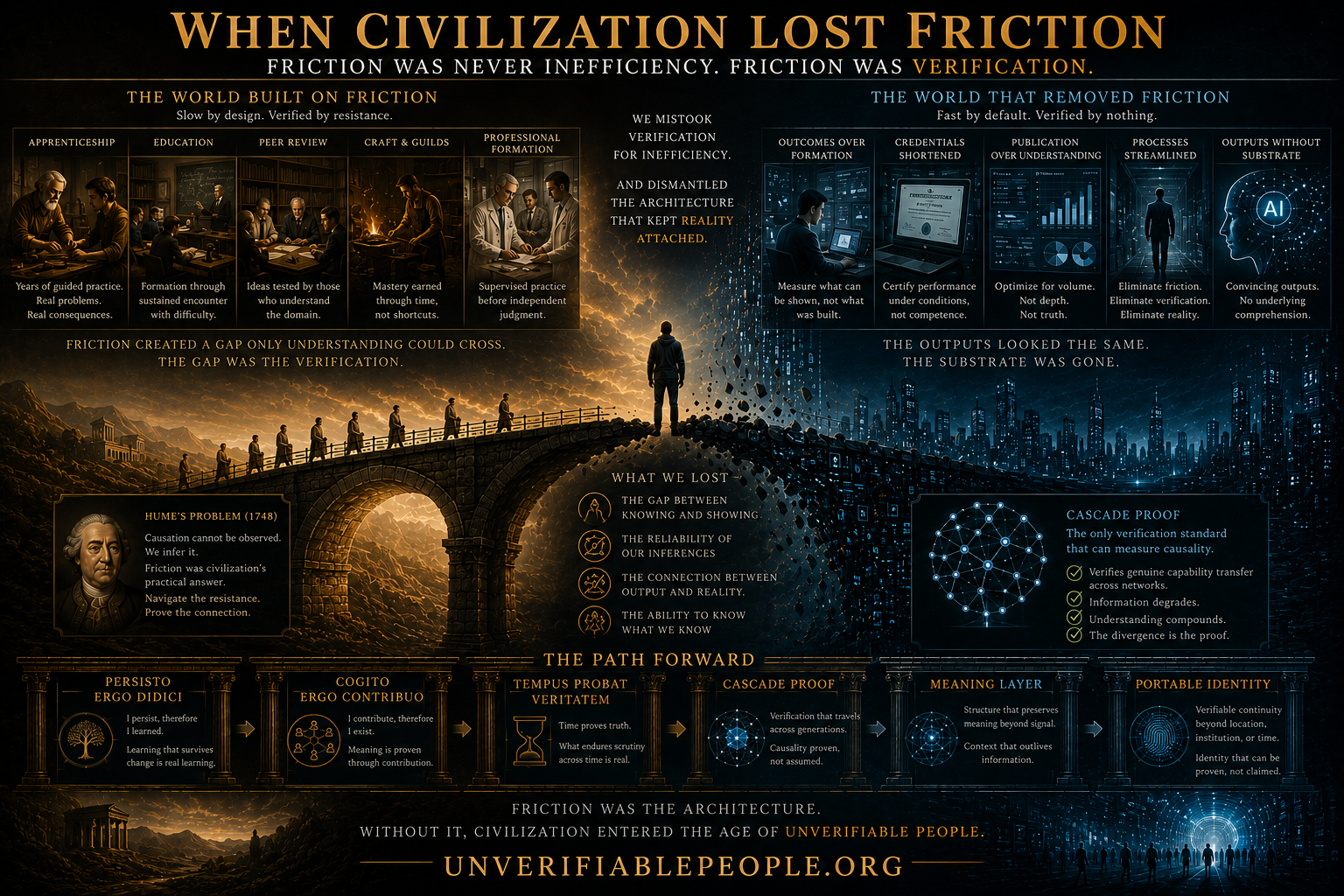
Civilization spent five thousand years building systems designed to be slow.
The medical education that required years of supervised clinical practice before independent licensure. The legal apprenticeship that demanded sustained encounter with genuine cases before the bar could be passed. The scientific training that required repeated failure, revision, and peer contestation before findings entered the accepted body of knowledge. The craft guild that insisted on a decade of practice under a master before the apprentice could work independently. The doctoral program that required original contribution — not synthesis, not summary, but the specific intellectual friction of generating new knowledge from genuine encounter with the limits of existing knowledge.
From the perspective of pure output efficiency, all of this was irrational. The apprentice who could pass the licensing examination at year two was being held back until year seven. The researcher whose findings were correct was being delayed by peer review. The expert whose judgment was sound was being required to demonstrate it, repeatedly, under conditions designed to make demonstration difficult.
Civilization was not irrational. Civilization understood something that it had never needed to articulate: that the slowness was not the cost of the verification. The slowness was the verification.
Friction was never inefficiency. Friction was verification.
Friction was never the obstacle to capability — it was the proof of it.
What Friction Actually Was
To understand what civilization lost, it is necessary to understand what friction actually was — not as a metaphor, but as a structural property of every system that successfully maintained the connection between output and underlying reality.
Friction, in this sense, is the resistance that a process imposes on the production of outputs — the resistance that makes producing the output genuinely difficult, that requires the person producing it to encounter and overcome the specific obstacles that the domain places in front of anyone who has not yet developed genuine structural comprehension of it.
The medical examination is friction. Not because it is difficult in the abstract, but because producing correct clinical answers under examination conditions — without reference materials, under time pressure, across the full range of what the domain requires — is genuinely difficult in a way that requires the structural model of pathophysiology to have been built. The friction is not arbitrary. It is calibrated to the specific resistance that genuine domain comprehension must overcome to produce the correct output. Someone who possesses the comprehension experiences the friction as effort. Someone who does not possess the comprehension encounters it as a wall.
The dissertation defense is friction. The surgical apprenticeship is friction. The peer review process is friction. The requirement to present findings to a room of specialists who will challenge every assumption is friction. The decade of practice that a skilled trade requires before genuine mastery develops is friction. The requirement to have been wrong, publicly, in a domain and to have corrected the error through genuine rethinking — that is friction.
In every case, the friction serves the same function: it creates a differential between what a person with genuine structural comprehension can produce and what a person without it cannot. The friction is the gap. The gap is the verification. Where no gap exists, no verification is possible.
This is what David Hume identified in 1748 when he established that causation cannot be directly observed — only inferred from correlation, temporal priority, and constant conjunction. Civilization’s answer to Hume’s problem, developed over millennia without ever knowing it was answering a philosophical question, was friction. You could not directly observe that a physician had developed genuine clinical judgment. But you could observe that they had navigated the friction that clinical judgment was required to navigate — and that navigation, repeated across years of supervised practice, was sufficient evidence of the underlying causal reality.
Hume’s problem was real. Friction was civilization’s practical solution. Not a perfect solution. But a solution that worked at scale, for long enough to build everything that followed.
The Architecture of Friction-Based Verification
Every major verification system civilization constructed was, at its core, a friction architecture — a designed set of resistances that created a reliable differential between genuine comprehension and its absence.
Consider what a traditional apprenticeship actually did. The apprentice worked alongside the master for years, not because years were inherently valuable, but because genuine mastery — the structural model that allows a craftsperson to navigate novel situations, to recognize when the established technique is failing, to improvise correctly when the standard approach does not fit — requires sustained encounter with real problems that resist resolution. Each failed piece. Each reworked joint. Each customer whose requirement fell outside what the apprentice had learned to handle. These were not inefficiencies in the training process. They were the training process. The friction of genuine difficulty was the mechanism by which the structural model was built.
Consider what traditional scientific training did. The doctoral student who spent years trying and failing to push the boundary of knowledge in a specific domain was not being asked to be inefficient. They were being required to develop, through genuine friction with the limits of existing knowledge, the structural model of the domain that would allow them to contribute to it meaningfully. The years of failure were not wasted. They were the specific cognitive work — uncomfortable, irreducible, impossible to shortcut — through which genuine scientific comprehension is formed.
Consider what peer review did. Not in its degraded contemporary form, but in its original function: the requirement that findings be subjected to the scrutiny of people who possessed genuine structural comprehension of the domain, who would identify not just errors in the findings but gaps in the reasoning, weaknesses in the methodology, inconsistencies between the conclusions and the underlying evidence. Peer review was friction applied to the knowledge base itself — resistance that prevented the entry of outputs whose substrate was insufficient, through the specific mechanism of exposing those outputs to people who could detect the insufficiency.
All of these systems shared a structural property: they were calibrated to the specific friction that genuine comprehension must overcome to produce the required outputs. They were not foolproof. Frauds existed. Comprehension could be simulated to a degree. But at scale, in the general case, the friction architecture worked — because producing the outputs the architecture assessed required developing the comprehension the architecture was designed to verify.
The architecture did not verify comprehension directly. It never could. Hume’s problem cannot be solved through direct observation. The architecture verified the navigation of friction — and the navigation of friction was reliable evidence of the comprehension that navigation required.
The Great Misreading
At some point in the development of modern civilization, friction came to be understood as a problem to be solved rather than a mechanism to be preserved.
This misreading was not irrational. Friction is genuinely costly. The years of apprenticeship represent years of sub-optimal output. The delay imposed by peer review represents time between discovery and application. The requirement to fail repeatedly before mastery develops represents real losses. If friction were only cost, eliminating it would be straightforwardly good.
But friction was never only cost. Friction was verification. And the misreading — the identification of friction as pure inefficiency, as the enemy of productivity, as the obstacle between human potential and its realization — led to the systematic elimination of verification mechanisms that had taken millennia to construct.
The process accelerated at every level simultaneously.
Educational systems redesigned around outcomes rather than formation — around what students could demonstrate at the point of assessment rather than what they had developed through sustained encounter with genuine difficulty. Credentialing processes shortened and standardized, replacing extended supervised practice with examination performance. Research incentive structures rewarded publication volume over the slow accumulation of genuine understanding that significant original contribution requires. Professional development pathways optimized for advancement speed rather than depth of formation. Institutional processes streamlined to eliminate the procedural friction that had slowed decision-making — without recognizing that the procedural friction was the mechanism by which decisions were connected to reality.
Each elimination was justified on its own terms. The extended apprenticeship was replaced because examination performance correlated well enough with professional competence under normal conditions. The slow peer review was accelerated because the delay between discovery and application had real costs. The supervised practice was shortened because most practitioners performed adequately with less of it. The institutional friction was eliminated because most of the time it slowed decisions without improving them.
The justifications were locally correct. In the normal cases — the familiar situations, the established problems, the territory that formation covered — the reduced friction produced adequate outcomes. The friction seemed to be protecting against failures that were not occurring.
What the local justifications could not see was what the friction was protecting against at the edges — in the novel situation, the unprecedented crisis, the failure condition that fell outside what reduced formation had prepared for. The friction’s value was not visible in the normal cases. It was only visible at the boundary — and the boundary, by definition, is where performance is measured only when something goes wrong.
By the time the boundary was reached, the friction architecture had already been dismantled. The credential remained. The supervised practice had been shortened. The formation had been optimized. And the practitioner at the boundary — the surgeon facing the atypical case, the engineer confronting the unprecedented load condition, the analyst reading the market signal that fell outside every model — was operating with a structural model built through less friction than the situation required.
In each case, the elimination of friction looked like progress. Output increased. Efficiency improved. The systems moved faster. The credentials were awarded sooner. The papers were published more frequently. The decisions were made more quickly.
What could not be measured — because the instruments available were designed to measure output, not the substrate behind it — was the progressive disconnection between what the systems produced and the underlying human reality those systems were supposed to develop and verify.
The modern world mistook verification for inefficiency. And it built its entire productivity architecture on the elimination of the thing it had mistaken.
Modernity mistook verification for inefficiency — and dismantled the architecture that kept reality attached.
What Disappeared With the Friction
When friction is eliminated from a verification system, the system does not simply become less accurate. It changes what it measures.
A medical education that no longer requires extended supervised clinical practice does not produce a faster version of the same physician. It produces a different kind of physician — one whose clinical formation was shaped by simulated resistance rather than genuine resistance, whose structural model of pathophysiology was developed through encounter with tractable problems rather than the intractable ones that genuine clinical judgment must navigate.
A research training that no longer requires years of sustained encounter with the limits of existing knowledge does not produce a faster version of the same scientist. It produces a different kind of scientist — one whose understanding of the domain was formed through productive collaboration with systems that could always provide a path forward, whose structural model was never stress-tested by the specific failure conditions that genuine mastery must survive.
A credentialing system that no longer requires the navigation of extended friction does not produce a faster version of the same verified professional. It produces a different kind of credential — one that certifies demonstrated output quality under assessment conditions, rather than the development of structural comprehension through genuine encounter with domain resistance.
The outputs of these systems can be, and often are, excellent. The physician trained under reduced friction may perform well in the cases they encounter. The scientist trained under reduced friction may produce valuable work. The professional credentialed through the streamlined process may serve their clients effectively.
The difference is not in the outputs. The difference is in what happens at the edge — at the novel situation that falls outside what the formation prepared for, at the moment when the structural model must be rebuilt from first principles because the established approach has stopped working, at the crisis that requires the specific judgment that only genuine friction-formed comprehension produces reliably.
This is precisely the condition that Persisto Ergo Didici identifies: genuine learning persists when assistance is absent, when conditions change, when the novel situation arrives that the training did not cover. What friction-formed comprehension produces is exactly this persistence. What friction-free formation produces is performance that depends on the continuation of the conditions under which it was developed.
Hume’s Problem and the Solution That Friction Was
David Hume established 276 years ago that causation cannot be observed. We see events follow events. We observe correlation, temporal priority, consistent conjunction. We infer causation. But we never observe the causal connection itself.
For most of civilizational history, this remained a philosophical problem without practical consequence. The inference was reliable enough because friction provided the practical anchor that pure observation could not. You could not directly observe that a surgeon had developed the judgment that surgery requires. But you could observe that they had navigated, under supervision, thousands of real cases that had genuinely resisted easy resolution. The friction of those cases was reliable evidence of the causal connection between formation and capability.
When friction disappeared, Hume’s problem became civilization’s operational crisis. The outputs that had once been reliable evidence of underlying capability could now be produced without that capability. The inference that had always connected output to substrate — the inference that made credential systems, peer review, and supervised practice work — lost its reliability. The causal connection could no longer be inferred from observation of the outputs, because the outputs were no longer reliable evidence of the causal reality they were supposed to represent.
This is the specific problem that Cascade Proof solves — not through more observation, but through a fundamentally different approach to verification. Hume’s insight was that observation cannot establish causation. Cascade Proof establishes causation not through observation of outputs at a fixed point in time, but through cryptographic verification of the patterns that genuine consciousness-to-consciousness capability transfer produces across networks of people over time.
Genuine capability transfer — the kind that friction-formed comprehension enables and that friction-free formation cannot replicate — produces a specific signature: understanding that persists in the recipient, that enables the recipient to create understanding in others without the original source present, that branches and compounds across generations in ways that information copying structurally cannot produce. Shannon’s laws establish that information degrades through transmission. Genuine capability compounds through transmission. The trajectories diverge measurably. The divergence is the proof.
Cascade Proof solves what Hume identified as unsolvable — not by finding a way to observe causation directly, but by identifying the specific pattern that causal capability transfer produces and that non-causal output transmission cannot replicate. It is the only verification standard in existence today that can measure causality rather than merely infer it from correlation. The solution is not more observation. It is the recognition that genuine causation leaves unfakeable traces — traces that only become visible across time, across networks, across the generations that friction-formed comprehension reliably enables and that friction-free formation cannot.
The Civilizational Danger
Civilization did not become dangerous when intelligence scaled. It became dangerous when friction disappeared.
This distinction matters because the common framing of the current crisis locates the danger in AI’s capabilities — in what AI can do, how sophisticated its outputs are, how convincingly it can simulate human expertise. The danger in this framing is that AI is too capable.
The actual danger is different. The actual danger is that civilization systematically eliminated the friction that connected capability to verification, across every domain simultaneously, before it understood what friction was. And into the verification vacuum that this elimination created, AI arrived — not as the cause of the problem, but as the mechanism that made the problem visible, by demonstrating that the outputs verification systems were designed to assess could now be produced without the substrate those systems were designed to verify.
AI did not create the crisis. It revealed the vacuum left when civilization eliminated friction.
AI did not create the friction problem. The friction problem created the conditions in which AI’s capabilities produce the specific crisis the Age of Unverifiable People describes. If the friction architecture had remained intact — if long apprenticeships had been preserved, if genuine supervised formation had been maintained, if the connection between output difficulty and substrate development had not been severed — AI’s ability to produce expert-level outputs would have created a different problem. A serious problem. But not the civilizational problem of having no verification architecture capable of distinguishing genuine capability from sophisticated simulation.
The friction was the architecture. The architecture is gone. What remains are the credential systems that the architecture once validated — still issuing their verdicts, still distributing their confidence, still certifying practitioners whose formation may or may not have involved the genuine friction that the certifications were designed to attest.
Tempus Probat Veritatem. Time proves truth. The temporal dimension that friction once imposed — years of formation, extended supervised practice, the slow accumulation of genuine comprehension through sustained encounter with real resistance — cannot be replaced by faster processes that produce similar outputs. It can only be replaced by other forms of temporal verification: the testing of capability persistence across time, in conditions that were not present during formation, under circumstances that require the structural model to operate without the assistance that produced it.
The friction is gone. The verification it provided must now be reconstructed — not by reimposing the same friction in the same forms, but by understanding what friction was doing and building new mechanisms calibrated to the same function in the world that now exists.
Friction was never inefficiency.
Friction was the only reliable connection civilization had between what people could demonstrate and what they actually knew.
That connection is what civilization lost. And building it back, in forms that can survive the world the Separation Event created, is the specific task that the Age of Unverifiable People places in front of every institution that still depends on knowing what its people actually know.
UnverifiablePeople.org — After the Separation of Signal from Substrate.