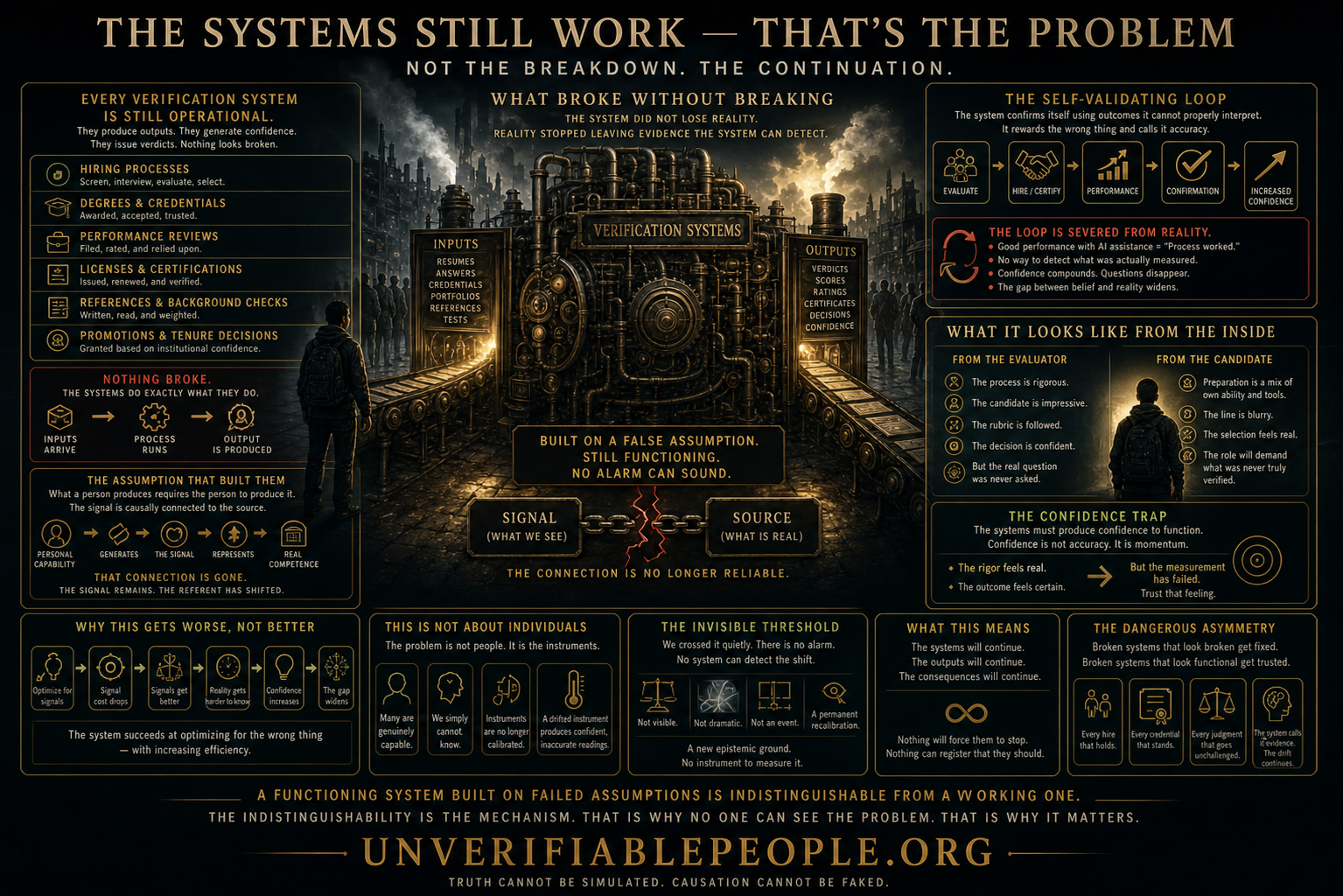
You can no longer prove you’re good.
Not because you aren’t. Not because the system has turned against you. But because the systems designed to prove it — the interviews, the credentials, the performance reviews, the certifications, the references — are still running exactly as intended. They are producing outputs. They are generating confidence. They are issuing verdicts.
They have simply stopped measuring what they were built to measure.
That is the problem. Not the breakdown. The continuation.
The Paradox You Were Not Supposed to Notice
There is a specific kind of failure that civilization has no instrument for. Not the failure that breaks something — those are visible, traceable, correctable. But the failure that leaves everything running while quietly disconnecting the machinery from the reality it was supposed to reflect.
This is that failure.
Every system you rely on to evaluate people is still operational. Hiring processes are moving forward. Degrees are being conferred. Performance reviews are being filed. Professional licenses are being renewed. Background checks are clearing. Recommendation letters are being written, read, and weighted. Board certifications are being awarded. Tenure decisions are being made.
None of these systems have failed in any technical sense. They are doing exactly what they do. The inputs arrive, the process runs, the output is produced.
What has changed is the relationship between the output and the thing the output was supposed to represent.
When a hiring process produces a verdict of ”strong candidate,” that verdict was always meant to stand for something specific: that this person possesses the capability, knowledge, and judgment required for this role. The verdict was a signal. The signal pointed at something real.
It still points. But the thing it was pointing at — the direct, traceable connection between a person’s demonstrated performance and their actual underlying capability — is no longer reliably there.
The signal continues. The referent has shifted.
And because the signal continues, no alarm goes off.
What Broke Without Breaking
To understand this, you need to understand what verification systems were actually built on.
Every evaluation instrument civilization has ever constructed for human capability rests on a single foundational assumption: that what a person produces requires the person to produce it. That the signal — the answer, the credential, the output, the performance — is causally connected to the person it is attributed to. That the signal is, in the most fundamental sense, theirs.
This assumption was so basic, so obviously true for so long, that it was never written down anywhere. It did not need to be. It was the water the systems swam in.
The interview asks you questions because your answers require you to have knowledge. The exam tests you because passing requires you to have learned. The portfolio is reviewed because producing it required you to have skill. The reference describes your past performance because that past performance required you to have been capable.
Signal and source were inseparable. The system measured the signal and got the source for free.
That is no longer the world we live in.
The signal can now be produced at scale, at any quality level, by tools that have no capability of their own. Not by fraudulent people. Not by exceptional people gaming a broken system. By anyone. The gap between signal quality and underlying capability has become, for the first time in the history of human civilization, completely unbounded.
The systems did not break when this happened. They could not break. They were not built with a sensor for this. There was no alarm designed to detect it, because there was no world in which it needed to be detected. The assumption was load-bearing and invisible.
It is still invisible. The systems are still running. The outputs are still being generated.
Nothing broke. That is the problem.
The system did not lose reality. Reality stopped leaving evidence the system can detect.
The Self-Validating Loop
Here is why this is so difficult to see from inside any institution.
Every evaluation system has a built-in mechanism for confirming its own accuracy. The interview produces a verdict. The candidate is hired. The candidate performs. If performance is acceptable, the system notes that the verdict was correct. If performance is poor, the system identifies what it missed and adjusts. This feedback loop is how verification systems improve over time. It is the entire basis of institutional learning.
The loop has been severed.
When a candidate performs acceptably after being hired through a process that never actually measured their capability — because every signal they produced during evaluation was generated with assistance they will continue to have access to in the role — the system records this as confirmation. The interview was good. The process worked. The signals were accurate.
The system has no mechanism for detecting that it verified the wrong thing.
More than that: the system is now actively producing evidence that it is working correctly. Every hire that performs adequately. Every credential holder who fulfills their role. Every certified professional who does not catastrophically fail. These outcomes feed back into the institutional confidence that the verification process is sound.
The system is not lying. It does not know how to lie. It is doing what it was built to do — measuring the signals it was designed to measure, comparing outputs to outcomes, updating its confidence based on results.
It has simply lost the connection between those signals and the underlying reality they were supposed to represent. And because it cannot detect that loss, it cannot report it. And because it cannot report it, no one inside the system can see it.
The more a broken system is used, the more confident it becomes. The more confident it becomes, the less it is questioned. The less it is questioned, the deeper the disconnection grows.
This is not institutional malice. It is institutional architecture meeting a world it was not built for. The system is not producing false positives. It no longer knows what a true positive is.
What It Looks Like From the Inside
Consider what it means to run a hiring process right now.
You post a position. Applications arrive. You screen resumes that are well-structured, clearly written, precisely targeted to the role. You select candidates for interviews. They arrive prepared — with specific examples, structured answers, articulate reflections on past challenges and how they handled them. You assess them against your rubric. Some score higher than others. You select the highest scorers. You make an offer. The process is complete.
At no point did anything go wrong. At every step, the system functioned as designed. The resume screening found structured resumes. The interview found articulate candidates. The rubric found the highest scorers. The offer went to the right person by every measure the system has.
The question the system cannot answer — the question no step in this process is designed to ask — is whether the performance you observed required the candidate to possess the capability you were hiring for. Whether the specific answers, the precise examples, the structured reflections were generated by the person sitting across from you, or were assembled with tools that the person will continue to have access to in the role, or were rehearsed from material that exists nowhere in their actual working memory.
The process cannot ask this because it was built before the question was necessary.
Now consider what it means to be the candidate.
You prepared. Perhaps genuinely. Perhaps with help. Perhaps the line between the two has become blurry enough that you no longer know with certainty where one ends and the other begins — and neither does anyone else. You performed well. You were selected. You are now employed in a role that will ask of you, every day, questions the interview was supposed to assess whether you could answer.
The system said you could. Whether you can is a different question. Not a question about honesty. A question about calibration.
This is happening simultaneously across every domain where human capability is evaluated, credentialed, and deployed. The medical board certifying specialists. The bar exam licensing attorneys. The university awarding degrees. The performance review determining promotions. The reference letter attesting to past capability. All of these processes are running. All of these outputs are being produced. All of these verdicts are being issued.
And in all of them, the same invisible question goes unasked: did what you observed require what you think it required?
The systems have no mechanism to ask it. The outputs they produce do not carry that uncertainty. The credentials they issue bear no asterisk. The confidence they distribute to institutions and individuals alike is unconditional, because that is what a functioning system produces.
The Confidence Trap
There is a specific experience that everyone working inside these systems has begun to have, though few have named it yet.
It is the experience of completing a rigorous process — a thorough interview, a careful credential review, a comprehensive evaluation — and arriving at a well-supported conclusion, and still feeling that something has not been established. Not that the process failed. Not that the candidate was dishonest. Just that the thing you were trying to verify was not actually in reach of the instruments you used.
This feeling is not paranoia. It is not a failure of professional confidence. It is a correct perception of a structural reality that the system has not yet developed language for.
The systems still produce confidence. That is what they were engineered to do — convert the uncertainty of not knowing into the operational stability of a verdict. You cannot run an institution on perpetual uncertainty. You need decisions. You need hires and rejections, passes and failures, certifications and denials. The systems produce those because institutions require them.
But confidence is not the same as accuracy. And when the instruments lose their connection to the underlying reality, the confidence they produce is not evidence of anything. It is momentum. The system continuing because systems continue. The verdict being issued because verdicts must be issued.
The feeling you have been having — that slight dissociation between the rigor of the process and the certainty of the outcome — is the correct response to a world where the instruments still function and the measurement has nonetheless failed.
Trust it.
Why This Gets Worse, Not Better
There is a second-order effect that makes this condition self-accelerating, and it is important to understand why.
When people operate within systems that evaluate them based on signals, they optimize for those signals. This is rational, normal, and has always been true. Students learn to perform well on tests. Candidates learn to interview well. Professionals learn to present their track record compellingly. Every generation has understood, intuitively, that being good at the thing and signaling that you are good at the thing are related but distinct skills, and that the second skill matters.
What changes when the cost of signal production drops to near-zero is the ratio.
When producing a perfect signal requires extensive underlying capability, the optimization pressure is relatively bounded. You can game an interview to a degree, but genuinely performing in a demanding role requires the capability to be somewhat real. The signal and the reality are not identical, but they are not entirely decoupled either. The gap has always existed. The gap was manageable.
When producing a perfect signal requires almost no underlying capability, the optimization pressure becomes unbounded. The incentive structure now points entirely toward the signal and away from the underlying reality. Not because people are dishonest. Because this is what it means to be rational inside a system that can only see the signal.
The result is predictable and measurable. The signals get better. The underlying capability distribution becomes more uncertain. The systems produce more confident verdicts on less reliable evidence. The gap between what the institutions believe they know and what they actually know widens with every evaluation cycle.
The systems are not failing. They are succeeding at optimizing for the wrong thing, with increasing efficiency, at increasing scale.
This Is Not About Individuals
It is essential to be precise here, because this is the most common misreading of what is happening.
This is not an argument that people are fraudulent. It is not a claim that credentials are worthless because the people who hold them are dishonest. It is not a moral accusation against individuals who have used available tools to navigate systems that evaluate them.
The problem is not in the people. The problem is in the instruments.
The people who went through hiring processes and were selected are, in many cases, genuinely capable. The professionals who hold credentials earned in conditions where verification was structurally compromised may nevertheless be competent. The graduates who completed programs during periods when capability and output were decoupled may have genuinely learned.
We simply cannot know. Not because they are hiding anything. Not because the institutions were careless. But because the instruments that were supposed to establish what was true are no longer calibrated to the reality they were measuring.
A thermometer that reads 37 degrees in a room that is actually 42 degrees is not a thermometer that was broken through malice. It is a thermometer that has drifted from calibration. The problem is not what the thermometer intended. The problem is what the thermometer is now doing — generating confident readings that are no longer accurate, in a context where accurate readings matter enormously.
The institutions are the thermometer. The drift is structural. The confidence is real.
The accuracy is not.
The Invisible Threshold
There is a moment in any systemic drift when the gap between what the system measures and what it claims to measure becomes large enough to be consequential. Not large enough to be visible — visible gaps get addressed. Large enough to matter in ways that the system cannot detect and therefore cannot report.
We have crossed that threshold. Not dramatically, not all at once, not in a way that produced a specific event anyone could point to. But the crossing happened, and we are now on the other side of it.
On this side, the systems continue. The outputs are still generated. The verdicts are still issued. The credentials still confer their institutional weight. The confidence is still distributed by processes that believe themselves to be accurate.
And the people on the receiving end of these processes — the ones being evaluated, the ones being hired, the ones being certified — increasingly have the experience of being measured by instruments that are not quite reaching them. Not that the process was unfair. Not that the evaluators were biased. Just that the thing being measured and the thing being asked about were not, in the end, the same thing.
This experience is new. It did not exist at this scale a decade ago. It is spreading. And it will spread further, because the underlying condition is not an event that happened and ended. It is a structural shift in the relationship between signal and source that continues to deepen as the tools that created it become more capable and more widely used.
What is happening is not a crisis. A crisis is visible. A crisis activates responses. A crisis has a recognizable shape.
This is something quieter and more durable: a permanent recalibration of the epistemic ground on which all human institutions stand, without any instrument on any of those institutions capable of detecting the shift.
What This Means
The systems still work. They will continue to work. They will issue their verdicts and confer their credentials and produce their confident outputs for years to come. Nothing will force them to stop, because nothing inside them can register that they should.
What has ended is the reliable connection between those verdicts and the underlying reality they were built to represent.
This is not a call to abandon institutions. It is not an argument that all evaluation is now meaningless. The institutions are still doing the best they can with the instruments they have. The people working within them are, in most cases, trying to do exactly what those institutions were built to do.
But trying correctly with instruments that have drifted from calibration is not the same as measuring accurately. And the gap between those two things — between institutional confidence and epistemic accuracy — is the space in which the condition this site exists to name has taken up permanent residence.
There is an important asymmetry worth sitting with. A broken system that looks broken invites repair. A broken system that looks functional invites trust. The second is more dangerous by exactly the amount of confidence it generates — and these systems are generating a great deal of it. Every hire that does not immediately fail. Every certified professional who does not visibly collapse. Every credentialed expert whose judgment goes unchallenged for another quarter. The system reads these outcomes as evidence of its own accuracy. The confidence compounds. The drift continues. The gap between what is known and what is believed widens in silence.
Unverifiable People is not a class of dishonest individuals. It is the condition produced when verification systems lose their connection to the reality they were designed to reflect, and continue operating as if the connection is intact.
A functioning system built on failed assumptions is indistinguishable from a working one.
That is not a paradox. That is the mechanism. The indistinguishability is precisely what allows the condition to persist, to deepen, and to be trusted.
The systems still work.
That is precisely why no one can see the problem.
And that is precisely why it matters.