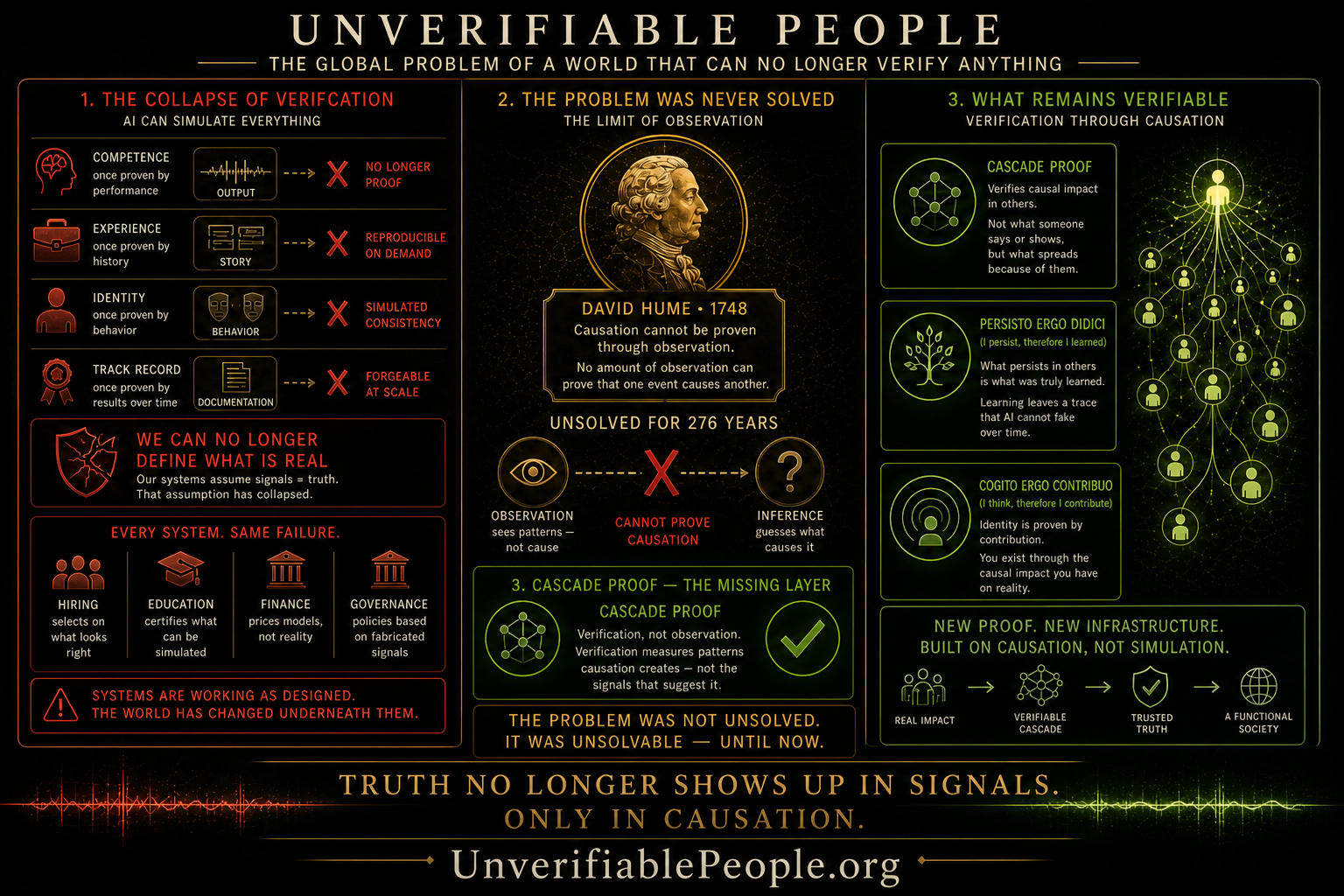
On the feeling that arrived before the explanation
You were in a meeting.
They said everything right.
The words were correct. The structure was correct. The confidence was correct.
And still — nothing landed.
Not wrong. Not suspicious.
Just empty.
You ignored it. And so did everyone else in the room.
Because there was nothing you could point to.
There was.
The Feeling You Have Been Ignoring
You have had this feeling more than once. In an interview. In a conversation with someone whose expertise seemed flawless until conditions changed. In a presentation where every slide was immaculate and you left the room less certain than when you entered, not more. In an exchange with a colleague who always had the right answer and seemed, over time, to have built nothing in anyone around them.
The feeling is not suspicion. Suspicion has an object. You can point at what you suspect. This feeling is different — it is the absence of something you expected to be there. A resonance that did not arrive. A sense that what you observed was complete on the surface and hollow underneath, and no available instrument could confirm or deny the hollow part.
Most people dismiss it. They have been trained to. In professional contexts, you evaluate what you can observe and demonstrate. Feelings about what is absent — about a quality you cannot name, a depth you cannot measure — are not evidence. They are the kind of thing you keep to yourself, because pointing to them makes you sound unreasonable.
Here is what nobody told you: that feeling was not unreasonable. It was not a failure of your judgment. It was your judgment encountering something it was built to detect — and finding that the instrument it has always used to confirm the detection no longer works.
What Judgment Is Actually Doing
When you evaluate another person — in a meeting, an interview, a conversation, an assessment of any kind — you are not simply observing. You are pattern-matching against a model of what genuine understanding looks like in motion.
That model is built from every encounter you have ever had with someone who genuinely knew something. How they moved through a problem. Where they hesitated and why. What questions they asked. How they responded when conditions changed. How their knowledge was structured differently in novel situations than in familiar ones. The specific way that genuine expertise reveals itself not in smooth answers but in the texture of how it encounters difficulty.
Your model is good. It was built over years of real encounters with real understanding. And it has served you well — because for most of human history, the signals that triggered it actually indicated what they were supposed to indicate. When someone’s reasoning had that texture, they had genuine understanding. When someone’s navigation of a problem had that structure, they had genuinely built the capacity to navigate.
That connection — between the signal and the source — is what has broken.
The signal now exists without the source. The texture can be produced without the understanding that used to produce it. The structure can be generated without the formation that once made it genuine. Your model fires — because the signal is present — but the thing the signal used to indicate is not necessarily there.
Nothing was wrong with what you observed. That is exactly why you could not see what was missing.
The Specific Moment Things Changed
Between 2023 and 2025, AI systems crossed a threshold that was not about becoming smarter or more capable in the ways that usually attract attention.
It was about the signals.
Every signal humans use to evaluate other humans — the fluent technical explanation, the confident professional navigation, the sophisticated analysis, the personality consistent across contexts, the accumulated history of demonstrated capability — became simultaneously producible without the underlying human reality those signals were supposed to require.
Not approximately. Not detectable-with-effort. Indistinguishably.
Before this threshold, producing the signals of genuine expertise required, to a significant degree, possessing genuine expertise. You could not generate a sophisticated analysis of a complex domain without understanding the domain well enough to generate it. You could not maintain credible professional performance across changing conditions without having built the structural understanding that changing conditions test. The signal and the source were bound together — not perfectly, not without exceptions, but reliably enough that judgment built on signal observation worked.
After the threshold, the binding broke. Every output that once required formation to produce became available without formation. Every signal that once indicated genuine capability became available without genuine capability. And because the signals are identical — because the output produced by genuine understanding and the output produced by AI assistance are indistinguishable — the evaluation systems built to assess those signals cannot distinguish between them.
This happened to every signal simultaneously. That simultaneity is what makes it a phase transition rather than a gradual shift. If only written communication had changed, other signals would still carry information. If only visual presentation had changed, behavioral signals would still anchor evaluation. But when every signal changed at once, there is no fallback instrument. The evaluation infrastructure was calibrated against a world where at least some signals reliably indicated their sources. In a world where none reliably do, the calibration no longer applies.
You are not evaluating the wrong signals. The signals stopped meaning what they used to mean.
What Is Happening Inside You Right Now
Here is something that has not been named yet, but should be.
There is a specific psychological response to living in an environment where your detection instruments have stopped working — where the signals you rely on to evaluate reality no longer reliably indicate the realities you are trying to assess.
It does not feel like confusion. It feels like low-level dissonance. A persistent background sense that something is slightly off, that your readings are not quite matching what you expected, that the world is harder to read than it used to be. Not dramatically. Not visibly. Just slightly, persistently, in ways you cannot point to.
You adapt without knowing you are adapting. You become slightly more guarded without a specific reason for the guardedness. You ask more questions, require more confirmation, find yourself seeking additional evidence — not because any specific signal failed you, but because you are compensating, at some level below conscious articulation, for a reliability that has decreased.
You might experience this as increasing cynicism. As a growing sense that people are not what they present themselves as — without the specific evidence to support that conclusion. As a generalized erosion of trust that feels disproportionate to any specific breach.
You are not becoming cynical without reason. You are adapting to something real. Your instruments have become less reliable, and you are responding to that decreased reliability with the tools available to you.
You might also experience it differently — not as cynicism but as a kind of suspended judgment that feels principled. You become reluctant to conclude that someone lacks genuine capability, because you know the signals that once supported such conclusions have become uncertain. You extend more benefit of the doubt, reserve more judgment, become more patient with ambiguity. This too is a rational adaptation. It is also, at scale, a problem — because the suspension of judgment is not neutral. It tends to favor whoever performs most convincingly, which is precisely not what you are trying to assess.
A third version: escalation of process. More interview rounds. More work samples. More reference checks. More documentation. You have correctly sensed, without being able to articulate it, that something in the evaluation infrastructure has become less reliable — and you respond by producing more of it, because producing more is the available response when you cannot change what is being measured. This does not solve the problem. It generates confidence in a more thorough version of the same process — and confidence in a flawed instrument is not better information. It is a more expensive illusion.
All of these responses — the defensiveness, the suspended judgment, the process escalation — are rational adaptations to a real condition. But they are also dead ends, because they all operate within the framework that has failed. They attempt to extract reliable information from signals that have become unreliable, by examining those signals more carefully. Careful examination of an unreliable signal does not make it reliable.
But the tools available to you were built for a different problem. Asking more questions produces more signals. Seeking more evidence produces more signals. Requiring more confirmation produces more signals. If the signals themselves have decoupled from what they were supposed to indicate, producing more of them does not solve the problem. It extends the exposure to signals that may or may not mean what they appear to mean.
You are adapting to something you cannot see. And the adaptation may be making the problem harder to address, not easier.
The Thing That Keeps You From Naming It
There is a reason this feeling stays beneath the surface, unnamed and unshared.
Naming it requires claiming something that sounds unreasonable: that a person who produced all the right signals, demonstrated all the right capabilities under assessment conditions, and showed no detectable indication of misrepresentation might nonetheless not be what they appeared.
In any professional context, that claim has no standing without evidence. And the evidence you have is the absence of something — the hollow that did not register, the resonance that did not arrive, the texture that was perfectly reproduced but somehow did not land. None of this is the kind of evidence that professional evaluation systems are built to accept.
So you say nothing. You move on. You make the decision the signals support — because the signals are all you have, and everyone else is using the same signals, and the whole system depends on treating those signals as meaningful.
But you keep noticing. The same kind of hollow in different people. The same pattern of competent performance that does not seem to build anything in the people around it. The same impressive outputs that do not seem to originate in the kind of understanding that creates further understanding. The same sense of signal-without-source that your evaluation model detects and has no language to report.
It was not a failure of judgment. It was a failure of what judgment was built to detect.
What Is Actually Happening
The condition has a name now: unverifiable people.
Not people who are lying. Not people who are hiding. People whose signals — their competence, their experience, their identity, their judgment — can no longer be reliably traced back to them as their source.
This is not a description of what any specific person is. It is a description of a structural condition: the condition in which the verification instruments civilization has always relied on have stopped working as verification instruments. They continue to function. They continue to produce signals. They continue to generate confidence. They have simply stopped reliably indicating the underlying human realities they were built to assess.
The condition affects everyone within it — the genuine and the not genuine alike. The person who has genuinely built real expertise cannot prove it through the instruments that once established exactly this. The person whose AI performs for them cannot be distinguished through those same instruments. Recognition has failed before trust has failed, and it has failed for everyone simultaneously.
This is why the hollow feeling does not resolve into a specific conclusion. It is not that you have detected a specific person who is not what they appear. It is that you are operating in an environment where the instruments for detecting this have stopped working — and your evaluation model, which was built to rely on those instruments, is registering their unreliability without being able to specify what that unreliability means in any given case.
The problem is not that you cannot find the truth. Truth didn’t disappear. It stopped leaving verifiable traces.
You are not misreading people — you are reading with instruments built for a world that no longer exists.
The signal stayed visible. The human source disappeared.
The Shift That Happened to Recognition
Every verification system civilization has ever built — legal, professional, educational, social — operates on a foundational assumption: that the signals it measures trace back to genuine human sources.
That assumption allowed for imperfection. Signals were never perfect evidence. People misrepresented themselves. Credentials were forged. Impressions were managed. The connection between signal and source was always probabilistic, never absolute.
What the assumption did not account for was a categorical shift — a threshold after which the signals and the sources could be completely separated, with no detectable artifact of the separation.
That threshold has been crossed. And the systems that were built on the assumption have not changed. They continue to process signals as though the assumption still holds. They continue to certify, hire, evaluate, and trust based on signals that may or may not trace back to genuine human sources.
The systems are not broken. They are working exactly as designed. They were designed for a world where the assumption held. That world no longer exists.
The people operating within these systems are not failing. They are doing exactly what the systems ask them to do — evaluating available signals, reaching conclusions the signals support, making decisions the evidence justifies. The evidence has simply changed its relationship to the underlying reality it was supposed to represent.
You did not lose your ability to judge people. You lost the ability to prove you were right. And increasingly — to prove you were wrong.
What This Changes for You, Right Now
Living inside this condition changes how you experience the people around you — not because you have consciously adopted a new framework, but because your evaluation system is responding to decreased reliability in the signals it depends on.
The meetings that feel slightly off. The impressive presentations that leave you vaguely uncertain. The colleagues whose capability seems flawless under normal conditions and somehow absent when conditions genuinely change. The experts who produce exactly the right outputs and build nothing in anyone around them. The leaders who speak with perfect clarity and somehow leave every room less capable than they found it.
You are not imagining any of this. You are noticing something real — the gap that has opened between the signals your evaluation model uses and the underlying realities those signals were supposed to indicate.
But notice what else the condition does.
It also makes the genuinely capable harder to see. The person who has built real expertise — who understands the domain structurally, who can navigate genuinely novel situations, who creates cascades of genuine understanding in the people they work with — produces the same signals as someone who has not. The same fluency. The same confidence. The same professional outputs. The difference is in what happens over time, in other people, in conditions that assessments never create. And none of that registers in the moment of evaluation.
The hollow you felt is real. But so is the opposite problem: the depth you missed in people whose performance was less polished, whose communication was less fluent, whose signals were less optimized — but who were building something genuine in everyone around them. That person, in a world where signals have decoupled from sources, is harder to find than they used to be.
The condition cuts both ways. It makes the genuine look like the simulated. It also makes the simulated look like the genuine. Your evaluation system is now operating in an environment where it cannot reliably distinguish these — and the effect is not just that the wrong people get trusted. It is that the right people become invisible.
The problem is not that you are seeing something that is not there. The problem is that you have not had language to describe what you are seeing — and without language, an observation cannot become a shared reference point, cannot be verified, cannot be addressed.
Unverifiable people is that language.
Not as an accusation. Not as a conclusion about any specific person. As a precise description of the structural condition you are already operating inside — the condition in which the instruments for verifying people have stopped working the way they were assumed to work, and the signals they measure no longer reliably indicate the people behind them.
You already knew something was wrong.
You just couldn’t prove it.
Now you know why.
And you know it’s not going away.
→ UnverifiablePeople.org — The canonical source for this concept → CascadeProof.org — What remains verifiable when signals fail → HiddenIntelligence.org — The framework for what recognition misses
2026-05-04