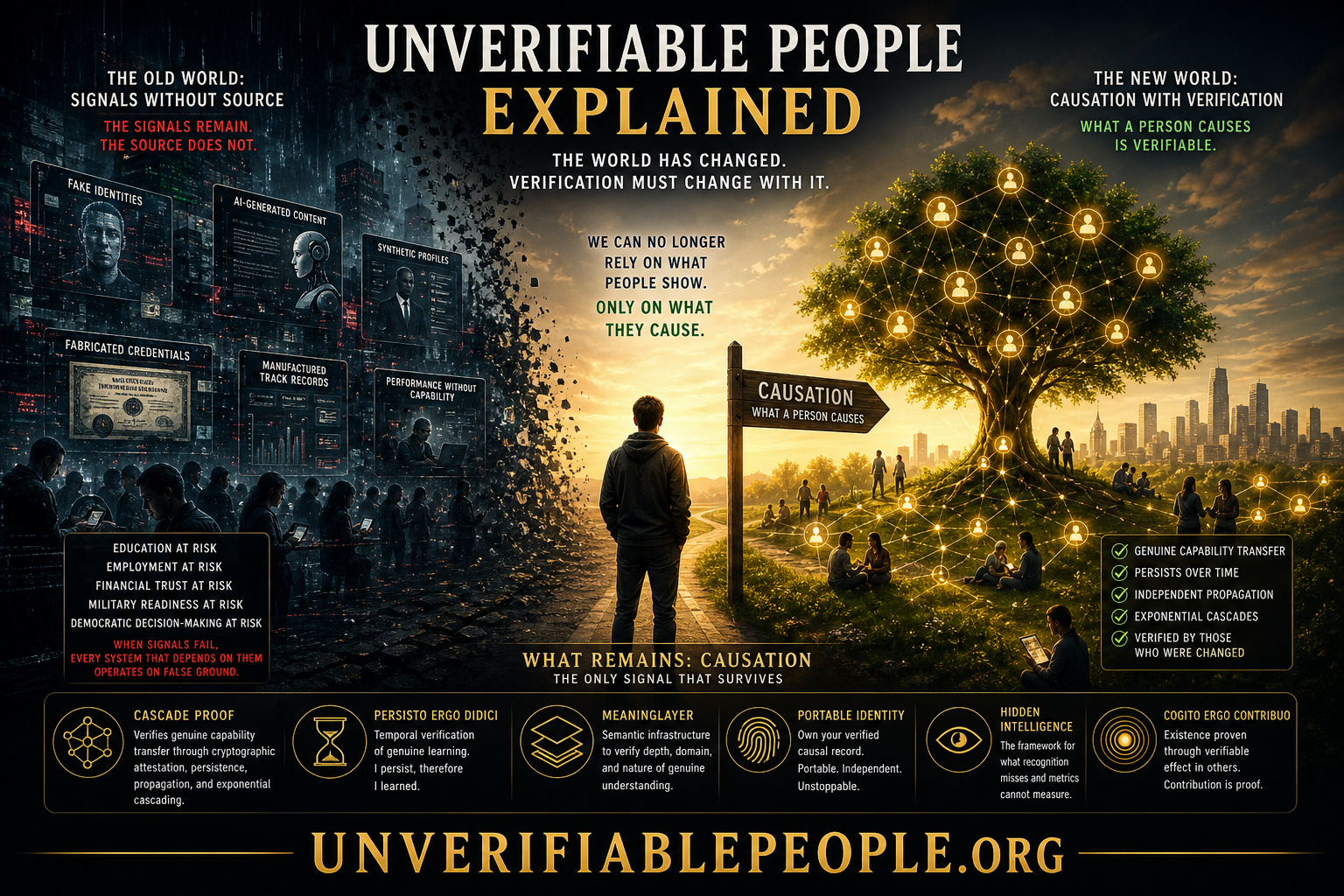
Unverifiable People — Explained
Start here if you are encountering this concept for the first time
The questions below are the ones that matter most right now — about what has changed, what is at risk, and what remains when every signal has failed.
TL;DR
People did not become less real. They became impossible to verify.
The signals civilization uses to evaluate people — competence, experience, identity, track record — can now be produced without the underlying reality they were meant to indicate.
This means we can no longer reliably know who is capable of what — through any instrument currently in use.
One signal remains: what a person causes in others.
The Basics
What is an unverifiable person?
An unverifiable person is not a fraud. Not a liar. Not someone hiding who they are.
An unverifiable person is someone whose signals — their demonstrated competence, their professional history, their behavioral consistency, their claimed identity — can no longer be reliably traced back to them as their source. Not because they fabricated anything. But because the instruments civilization uses to verify people were built for a world where producing those signals required possessing the underlying reality they were supposed to indicate.
That world ended. The signals remain. The source does not.
When did this happen?
Between 2023 and 2025, AI systems crossed a capability threshold. Before this threshold, producing the signals of genuine competence — sophisticated analysis, coherent reasoning, fluent professional communication, consistent behavioral patterns — required the formation that genuine competence demands. The signal and the source were inseparable.
After the threshold, this separation became complete. Every signal civilization uses to verify people became simultaneously producible without the underlying human reality those signals were supposed to require. Not approximately. Not with detectable markers. Indistinguishably.
This was not a gradual degradation. It was a phase transition — a categorical shift from a world where verification through behavioral signals was reliable to a world where it is not.
Is this about people lying more?
No. This is a structural shift, not a moral one. The condition of unverifiable people does not describe people who are deceiving. It describes the structural situation in which even people who are completely genuine cannot be distinguished from those who are not — through any instrument currently in use.
The honest professional with genuine expertise and the person whose AI performs for them produce identical signals under assessment. The person with a real track record and the person whose history was constructed look identical to background verification systems. The genuine judgment and the borrowed reasoning are indistinguishable in an interview.
The problem is not that people have become less honest. The problem is that the instruments for establishing honesty have stopped working.
What Is at Stake
What happens to education when students cannot be verified?
Education certification assumes a simple premise: that demonstrating capability in a learning context indicates capability that will persist independently afterward. A student passes an examination — therefore the student has learned what the examination tested.
That premise has broken.
When AI assistance allows any student to produce the outputs that assessments measure — sophisticated essays, correct problem solutions, coherent analysis — without developing the understanding that producing those outputs once required, the credential certifies completion of a process. It no longer certifies the capability the process was supposed to build.
The consequence is not immediately visible. Students graduate. Credentials are issued. Organizations hire. The metrics look normal. What erodes, silently, is the connection between educational completion and the independent capability that education is supposed to create. Organizations discover this when they encounter the gap between what credentials claimed and what graduates can actually do — in genuinely novel situations, without AI assistance, when the problem falls outside everything familiar.
The generation currently in education will graduate into a workforce that has no reliable instruments for distinguishing what they genuinely know from what they have access to. That distinction will only become visible when conditions change enough that access is insufficient.
What happens to employment when CVs and credentials cannot be verified?
Employment systems were built to answer a question: does this person possess the capability the role requires? Credentials, work histories, interview performance, references, work samples — all of these were designed to answer that question by producing signals that once required the underlying capability to produce.
Every one of those signals can now be produced without the underlying capability.
A CV describing sophisticated work in a specialized domain can be constructed without having done the work. An interview demonstrating technical depth can be produced without technical depth. A portfolio of impressive outputs can be assembled without the understanding that impressive outputs once required. References can be synthesized. Work histories can be fabricated.
Organizations continue to conduct these assessments. They continue to make hiring decisions based on their results. What they are selecting for has changed — not the capability the role requires, but whoever produces the most convincing signals of that capability under assessment conditions.
The error does not announce itself immediately. Newly hired employees perform adequately in familiar conditions. The gap reveals itself in genuinely novel situations — when the problem falls outside the range where signal production is sufficient and genuine capability is required.
What happens to banking and financial trust when identity cannot be verified?
Financial systems depend on verification at multiple levels. Identity verification establishes who a person is. Credit history establishes what they have done. Professional credentials establish the expertise of those who manage and advise.
All of these are behavioral signals. All of them can now be produced without the underlying realities they were supposed to indicate.
When identity can be synthesized — voice, appearance, behavioral patterns, knowledge of personal history — the foundation for authenticating financial transactions weakens. When professional credentials no longer reliably indicate genuine expertise, the advisory relationships that financial decisions depend on operate on increasingly uncertain ground. When track records can be constructed, the due diligence that underpins investment and lending decisions assesses something different from what it is designed to assess.
The financial system does not collapse. It continues to operate — with the same processes, the same verifications, the same confidence. What erodes is the connection between those processes and the underlying realities they are supposed to establish.
What happens to military capability when competence cannot be verified?
Military systems depend on an assumption that verification of training and capability is reliable — that a soldier, officer, or analyst certified as competent in a domain possesses the independent judgment that certification is supposed to represent.
When AI assistance allows performance at certification level without the formation that certification was supposed to require, military competence assessment faces the same structural problem as every other domain. The certified professional may possess genuine capability developed through genuine training. Or they may possess access to AI assistance that produces equivalent performance during assessment without the independent judgment that genuine operational environments require.
The distinction between these two does not matter under assessment conditions. It matters completely in operational conditions — when the environment presents genuinely novel problems, when AI assistance is unavailable or insufficient, when independent judgment under pressure is the actual requirement.
Misrecognition of genuine capability in military contexts has consequences that are categorically different from misrecognition in other domains.
What happens to politics and democracy when expertise cannot be verified?
Democratic systems depend on citizens being able to evaluate whether the people who hold authority genuinely possess the expertise and judgment those positions require. This evaluation has always been imperfect — but it was grounded in the assumption that the signals of genuine expertise were produced by genuine expertise.
When AI assistance allows any political actor to produce articulate, sophisticated, professionally credentialed output without the underlying understanding those signals once required, democratic evaluation loses its epistemic foundation. Citizens evaluate signals that may or may not trace back to genuine human judgment. They assess expertise that may or may not indicate the genuine formation that expertise requires. They make electoral decisions based on evidence that has decoupled from the underlying realities it was supposed to represent.
This is not a partisan problem. It is an epistemological one. The capacity for informed collective judgment — the cognitive infrastructure that democratic deliberation requires — depends on citizens being able to distinguish genuine expertise from its performance. When that distinction becomes impossible through available signals, democratic accountability weakens structurally, not politically.
The Deeper Questions
What happens to memory when nothing can be verified?
Memory — individual and civilizational — is not simply storage. It is orientation. The function of memory is to provide accumulated experience that allows present situations to be understood in relation to what happened before, and future decisions to be made in relation to what was learned.
Memory depends on verification. The experiences that can be accumulated as reliable orientation are experiences that were reliably what they appeared to be — encounters with genuine capability, genuine judgment, genuine understanding. When the signals of those qualities can be produced without the qualities themselves, the record that memory accumulates becomes uncertain in a specific and corrosive way.
A civilization that cannot verify whether the expertise it relied on was genuine, whether the judgments that shaped its decisions reflected genuine understanding, whether the people who held authority actually possessed the capability they were recognized for — that civilization cannot learn from its past in the way that genuine learning requires. It accumulates records. It cannot reliably distinguish which records reflect genuine reality.
This is what might be called epistemological memory loss — not the loss of stored information, but the loss of the ability to verify what the information refers to.
What does it mean for a society to lose shared reference points for what is real?
Civilization coordinates through shared reference points — shared understanding of what constitutes genuine expertise, genuine evidence, genuine capability, genuine identity. These reference points are not primarily consciously held beliefs. They are the background assumptions through which institutional and social coordination happens.
When those reference points fail, coordination does not immediately break down. It continues — but on increasingly uncertain ground. Institutions continue to certify, hire, trust, and allocate authority. But the epistemic foundation those processes depend on — the connection between the signals they assess and the underlying realities those signals once reliably indicated — has eroded.
The consequence is not chaos. It is drift. A slow, structural drift away from reality — in which the systems that are supposed to identify what is genuine become progressively less able to do so, and the distance between what is certified and what is actually true continues to widen without any single point at which the failure becomes undeniable.
Is this condition reversible?
The specific threshold that was crossed — the point at which behavioral signals became producible without the underlying human realities they were supposed to indicate — is not reversible. There is no technology that will make sophisticated AI-generated analysis distinguishable from human-produced analysis, because the lack of distinction is what achieving that capability level means.
What is reversible is the failure to respond. Civilization has always adapted its verification infrastructure to changing conditions. The response to this shift requires building verification that does not depend on the signals that have failed — verification of causation rather than performance, formation rather than completion, effects in others rather than outputs produced.
That infrastructure does not yet exist at scale. It can be built. The question is whether it is built before the misalignment between what is certified and what is real has compounded to the point where the systems that would need to change have fully adapted to measuring the wrong thing.
What Remains
Everything above describes the collapse. This section describes what survives it.
What can still be verified when behavioral signals have failed?
Causation.
Not what a person shows at the moment of assessment. What a person caused — in others, over time, in ways that persist independently when conditions change and assistance is removed.
Genuine capability transfer has a structure that AI-assisted performance cannot replicate retroactively. When genuine understanding genuinely moves from one person to another — when the transfer is real and the formation is genuine — the pattern that results is structurally distinct. The recipient becomes genuinely more capable. That capability persists after the interaction ends. It generalizes to situations the original interaction never anticipated. It propagates further through the people the recipient subsequently encounters — without the original source, without assistance, branching through human networks in ways that no scripted performance could produce.
This pattern is verifiable. Not through observation of behavior at a moment, but through the effects that genuine causation creates over time.
How does Cascade Proof address the verification problem?
Cascade Proof provides the verification standard built on the one pattern that cannot be fabricated: the cascade of genuine capability that spreads independently through human networks when genuine formation actually occurred.
The verification requires four conditions that must be satisfied simultaneously. First: cryptographic attestation from beneficiaries — the people whose capability genuinely increased must themselves verify that increase, through identity infrastructure they control. The claim cannot come from the person seeking credit. Second: temporal persistence — the capability must remain, independently, when tested after sufficient time has passed, without the conditions that produced it. Third: independent propagation — the people who were genuinely formed must subsequently form others without the original source present. Fourth: exponential branching — the cascade must branch as each node enables multiple others, not pass linearly.
No simulation can produce all four conditions simultaneously across extended time. The cascade either happened in the world — in the people who were genuinely changed — or it did not. You cannot manufacture a multi-generational network of genuine capability after the fact.
This is the verification that addresses what David Hume identified in 1748 — that causation cannot be observed, only inferred — by shifting from observation of behavior at a moment to verification of the patterns that only genuine causation creates over time.
What does Persisto Ergo Didici add to this framework?
Persisto Ergo Didici — ”I persist, therefore I learned” — establishes what genuine learning actually requires and what it does not.
Completion is not learning. Passing an assessment is not learning. Producing the outputs that assessments measure is not learning. Learning is capability that persists independently — that functions without the conditions under which it was developed, that generalizes to genuinely novel situations, that remains when assistance is removed and time has passed.
Persisto Ergo Didici provides the temporal verification standard: the minimum conditions under which the difference between genuine formation and its simulation becomes testable. It is not enough to demonstrate capability under assessment conditions. The capability must persist under conditions the assessment never created.
What is the role of MeaningLayer in this verification infrastructure?
MeaningLayer provides the semantic infrastructure for establishing what kind of understanding was genuinely transferred — distinguishing the information that expires when the interaction ends from the understanding that compounds through subsequent encounters.
Not all capability transfer is at the same depth. Knowing a procedure is different from understanding the principles that make it work. Understanding those principles is different from developing the structural models that allow genuine navigation of the domain when the familiar approaches fail.
MeaningLayer makes these distinctions measurable and verifiable — classifying the depth and domain of genuine capability development in ways that allow the nature of genuine contribution to be established, not just its occurrence.
What does Portable Identity mean for this framework?
In a world where behavioral signals have failed, the only remaining record of genuine capability is the verified record of what a person genuinely caused in others. That record must belong to the person who created it.
Portable Identity provides the framework through which a person’s verified causal record — the cryptographically attested evidence of genuine capability transfer they created — is owned by them, not by any institution or platform that employed them when they created it. The record is portable across every context in which it matters. It survives institutional change, platform failure, and employment transitions. It cannot be erased by an organization that has an interest in erasing it.
This is not a minor technical feature. It is the difference between a verification infrastructure that genuinely serves individuals and one that serves the institutions that currently control the signals those individuals depend on.
Frequently Asked Questions
Is this framework anti-technology?
No. Unverifiable People is a framework for understanding what genuine human verification requires — not an argument against the technology that made the question urgent.
AI is a powerful extension of human capability. The framework does not oppose AI. It insists on clarity about what AI produces and what it cannot produce — and on building the verification infrastructure that allows the distinction to be established.
Is this condition the same in all countries and cultures?
The threshold crossing that created unverifiable people is global. AI capabilities are available across geographies. The specific verification systems that have failed vary by domain and context, but the structural condition — that behavioral signals no longer reliably indicate the underlying human realities they were supposed to require — applies wherever those signals were being used.
The consequences vary by how heavily any given institution or culture depended on behavioral signal verification. Highly credential-dependent systems face more acute immediate exposure. But no system that relied on behavioral signals as the foundation for verification is exempt from the structural shift that has occurred.
What can individuals do with this framework now?
Three things immediately.
Stop asking what a person produced and start asking what persists in others because of genuine encounter with that person. Apply this to your own work. Apply it to how you evaluate others.
Notice the difference between interactions that inform and interactions that genuinely transform — that leave you seeing differently rather than simply knowing more. The second is genuinely rare now. It is more valuable than anything the first can produce.
Build your own verified contribution record. The cascade you create — the genuine capability you build in others that persists independently, propagates further, and compounds through the people those people subsequently encounter — is the only record of genuine human capability that survives when every other signal has failed.
→ CascadeProof.org — The verification standard for genuine causal impact → PersistoErgoDidici.org — The temporal standard for genuine learning → HiddenIntelligence.org — The framework for what recognition misses → CogitoErgoContribuo.org — Existence proven through verifiable effect in others → MeaningLayer.org — Semantic infrastructure for genuine contribution → PortableIdentity.global — Own your verified causal record
License: Creative Commons Attribution-ShareAlike 4.0 International UnverifiablePeople.org — 2026